
Introduction
The FIFA World Cup has always been a stage where the world’s greatest soccer players showcase their talent. However, the 2026 FIFA World Cup will be remembered for more than incredible goals, unforgettable matches, and passionate fans. It is set to become the most technologically advanced World Cup in history.
Hosted jointly by the United States, Canada, and Mexico, the tournament will feature 48 teams and millions of fans from around the globe. Behind the scenes, a powerful combination of artificial intelligence (AI), smart sensors, advanced cameras, real-time analytics, and innovative broadcasting technology will reshape how the game is played, officiated, and experienced.
From AI-powered offside detection to connected match balls and immersive viewing experiences, technology is becoming an integral part of modern soccer. FIFA’s goal is clear: improve fairness, increase accuracy, enhance fan engagement, and bring the sport into a new digital era.
In this article, we explore the groundbreaking technologies expected to define the 2026 FIFA World Cup and how they could permanently change the future of soccer.
The Evolution of Technology in Soccer
Soccer was once considered one of the most traditional sports in the world. For decades, referees relied entirely on their judgment, and controversial decisions were simply accepted as part of the game.
That began to change with the introduction of goal-line technology, which accurately determines whether the ball has crossed the goal line. Soon after, Video Assistant Referee (VAR) technology was introduced to review key decisions.
While VAR significantly improved decision-making, it also sparked debates about delays, consistency, and interpretation. FIFA responded by investing heavily in next-generation technologies designed to make officiating faster, more accurate, and less disruptive.
The 2026 World Cup represents the next step in that evolution.
AI-Powered Semi-Automated Offside Technology
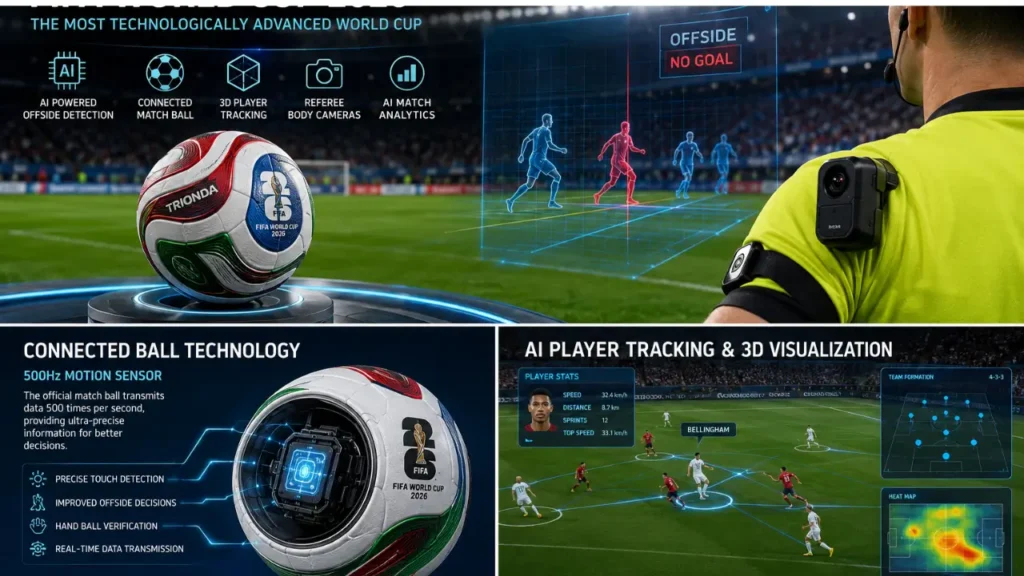
One of the most important innovations expected to be used during the tournament is the latest version of Semi-Automated Offside Technology (SAOT).
Offside decisions have always been among the most controversial aspects of soccer. Determining whether a player was ahead of the last defender at the exact moment the ball was played can be incredibly difficult, even when using slow-motion replays.
The upgraded SAOT system uses artificial intelligence combined with dozens of high-speed cameras installed throughout the stadium.
These cameras continuously track players and the ball throughout the match. AI algorithms analyze player positions in real time and instantly identify potential offside situations.
When an offside is detected, the system automatically alerts match officials, dramatically reducing the time required for reviews.
Benefits of AI Offside Technology
- Faster decisions
- Greater accuracy
- Reduced human error
- Less interruption to gameplay
- Improved transparency for fans
The result is a smoother viewing experience and increased confidence in officiating decisions.
Smart Connected Match Balls
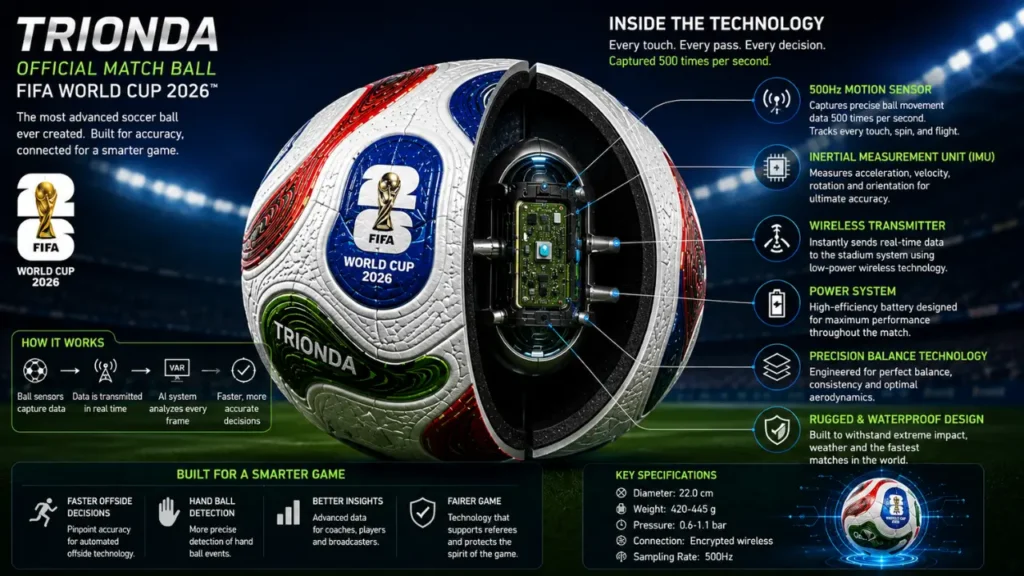
Another major technological advancement is the use of connected match balls equipped with sophisticated sensors.
The official World Cup ball contains an internal motion sensor capable of transmitting data hundreds of times per second. This technology allows officials to determine precisely when a player touches the ball.
At first glance, this may seem like a minor improvement. However, the exact timing of ball contact is crucial for offside decisions, handball rulings, and other important moments.
Combined with AI-powered tracking systems, smart balls create a highly detailed digital representation of every play.
How Smart Balls Improve Soccer
The technology helps officials:
- Detect touches more accurately
- Improve offside reviews
- Verify handball incidents
- Enhance match analysis
- Generate advanced statistics
For players and coaches, this data provides valuable insights into performance and tactics.
Digital Player Tracking and 3D Avatars
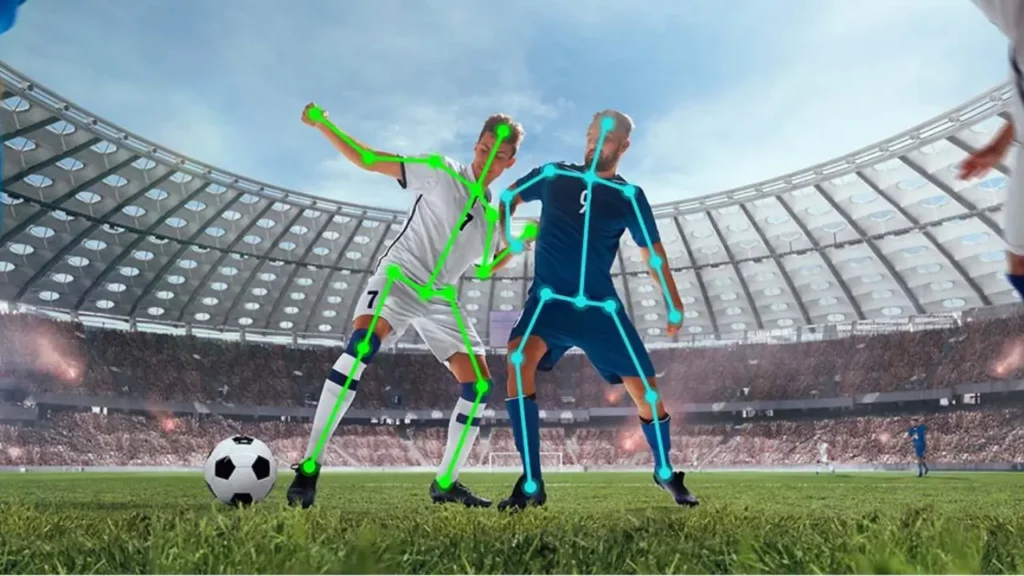
One of the most futuristic innovations expected at the 2026 World Cup is the use of digital player avatars.
Before the tournament begins, players may undergo advanced scanning procedures that create highly detailed 3D models of their bodies.
These digital replicas help AI systems track player movements with incredible precision.
During matches, millions of data points are collected regarding:
- Speed
- Acceleration
- Positioning
- Movement patterns
- Physical exertion
The information is then used to generate accurate visualizations for referees, broadcasters, analysts, and fans.
Enhanced Broadcast Graphics
Viewers may see:
- Real-time player positioning
- 3D offside reconstructions
- Tactical movement analysis
- Heat maps
- Sprint tracking
These visual tools make the game easier to understand while providing deeper insight into team strategies.
Artificial Intelligence in Match Analysis
Artificial intelligence is becoming one of the most powerful tools in professional sports.
At the 2026 World Cup, AI systems will analyze enormous amounts of data before, during, and after matches.
These platforms can evaluate:
- Team formations
- Passing networks
- Defensive weaknesses
- Player fatigue
- Tactical trends
Instead of spending hours manually reviewing footage, coaches can receive instant recommendations generated by AI.
Benefits for Teams
AI-driven analysis helps teams:
- Prepare more effectively
- Identify opponent tendencies
- Optimize player performance
- Reduce injury risk
- Improve decision-making
As AI technology continues to evolve, its role in elite soccer is likely to become even more significant.
Referee Body Cameras
Referee body cameras are another exciting innovation expected to receive increased attention during the World Cup.
These cameras provide a unique first-person perspective of the game, allowing viewers to experience matches from the referee’s point of view.
The footage can serve several purposes:
Training Officials
Referees can review their positioning, decision-making, and communication after matches.
Improving Transparency
Fans gain a better understanding of what referees see during critical moments.
Enhancing Broadcasts
Television networks can offer exciting new angles that bring viewers closer to the action.
Advanced AI stabilization technology helps ensure smooth, high-quality footage even during fast-paced moments.
Advanced Stadium Technology
The 2026 World Cup will take place in some of the most technologically sophisticated stadiums ever built.
Modern venues feature:
- High-speed connectivity
- Smart security systems
- AI-powered crowd management
- Digital ticketing
- Real-time monitoring systems
These technologies improve both safety and convenience.
Smart Crowd Management
AI systems can analyze crowd movement patterns and help stadium operators:
- Prevent congestion
- Improve entry and exit flow
- Respond to emergencies faster
- Enhance overall fan safety
With millions of visitors expected during the tournament, these capabilities are becoming increasingly important.
Immersive Fan Experiences
Technology is not only changing what happens on the field—it is transforming how fans experience the tournament.
Augmented Reality (AR)
Fans may be able to use smartphones or AR glasses to access:
- Live player statistics
- Interactive match information
- Virtual replays
- Real-time tactical analysis
Virtual Reality (VR)
VR technology could allow supporters to feel as though they are sitting inside the stadium, even from thousands of miles away.
This immersive experience could become especially valuable for international fans unable to travel to host cities.
Personalized Content
AI systems can customize content based on fan preferences, delivering:
- Favorite player highlights
- Team-specific updates
- Customized statistics
- Personalized notifications
The result is a more engaging and interactive viewing experience.
Big Data and Performance Optimization
Big data has become a major component of modern sports science.
Every movement made by players can now be tracked and analyzed.
Teams use this information to measure:
- Running distance
- Sprint frequency
- Recovery rates
- Physical workload
- Injury risk indicators
By monitoring these metrics, coaches can make smarter decisions regarding training and player rotation.
Injury Prevention
One of the most valuable applications of sports analytics is injury prevention.
AI systems can identify signs of fatigue before they become serious problems.
This allows teams to:
- Adjust training loads
- Schedule recovery sessions
- Reduce injury risks
- Extend player careers
As tournaments become increasingly demanding, these capabilities provide a competitive advantage.
Cybersecurity at the World Cup
With so much technology involved, cybersecurity has become a critical priority.
The World Cup relies on interconnected systems that manage:
- Ticketing
- Broadcasting
- Data analysis
- Communication networks
- Financial transactions
Protecting these systems from cyber threats is essential.
Security Measures
Organizers are expected to implement:
- Advanced encryption
- AI-powered threat detection
- Multi-factor authentication
- Continuous monitoring
Strong cybersecurity ensures that fans, teams, and broadcasters can operate safely throughout the tournament.
Sustainability Through Technology
The 2026 World Cup is also expected to emphasize environmental responsibility.
Technology can play a major role in reducing the tournament’s environmental impact.
Smart Energy Systems
Modern stadiums use intelligent systems that optimize:
- Lighting
- Air conditioning
- Water usage
- Power consumption
Digital Ticketing
Electronic tickets reduce paper waste and streamline stadium access.
Transportation Optimization
AI-powered traffic management systems can improve transportation efficiency and reduce emissions.
These innovations support FIFA’s broader sustainability objectives.
The Future of Soccer Technology
The technologies showcased during the 2026 World Cup may eventually become standard across professional soccer.
Future innovations could include:
- Fully automated offside decisions
- AI-assisted refereeing
- Predictive injury analysis
- Real-time tactical recommendations
- Enhanced virtual fan experiences
As technology continues to advance, the line between sports and digital innovation will become increasingly blurred.
Some experts believe that artificial intelligence could eventually become as important to soccer as physical training and coaching.
Challenges and Concerns
Despite its benefits, technology in soccer remains controversial.
Critics argue that excessive reliance on technology may:
- Slow down matches
- Reduce spontaneity
- Create new forms of controversy
- Diminish the human element of officiating
Others worry about privacy concerns related to player tracking and data collection.
Balancing innovation with the traditional spirit of the game will remain an important challenge for FIFA and the broader soccer community.
Conclusion
The 2026 FIFA World Cup represents a turning point in the history of soccer technology.
Artificial intelligence, smart match balls, advanced player tracking, immersive broadcasting, and powerful analytics systems are transforming every aspect of the sport.
These innovations promise greater accuracy, improved fairness, enhanced fan engagement, and deeper tactical understanding.
While debates about technology’s role in soccer will continue, one thing is certain: the future of the world’s most popular sport is becoming increasingly digital.
As billions of fans tune in to watch the tournament, they will witness not only the world’s best players competing for glory but also the next generation of sports technology in action.
The 2026 World Cup may ultimately be remembered as the tournament that ushered soccer into a new era—one where artificial intelligence and innovation become as influential as the players themselves.
Interested in discovering how artificial intelligence is transforming the world? Check out our latest articles on The Incredible Rise of Humanoid Robots https://growthpoweredai.com/2026/06/02/incredible-rise-of-humanoid-robots/
Emily Carter
Technology Editor at GrowthPoweredAI
Emily Carter is a technology writer specializing in artificial intelligence, automation, future technology trends, and digital innovation. She researches the latest AI tools, emerging technologies, and business automation strategies to help readers understand how technology is shaping the future. Through in-depth research and practical insights, Emily creates informative content designed for entrepreneurs, professionals, and technology enthusiasts. Read more articles by Emily on GrowthPoweredAI.