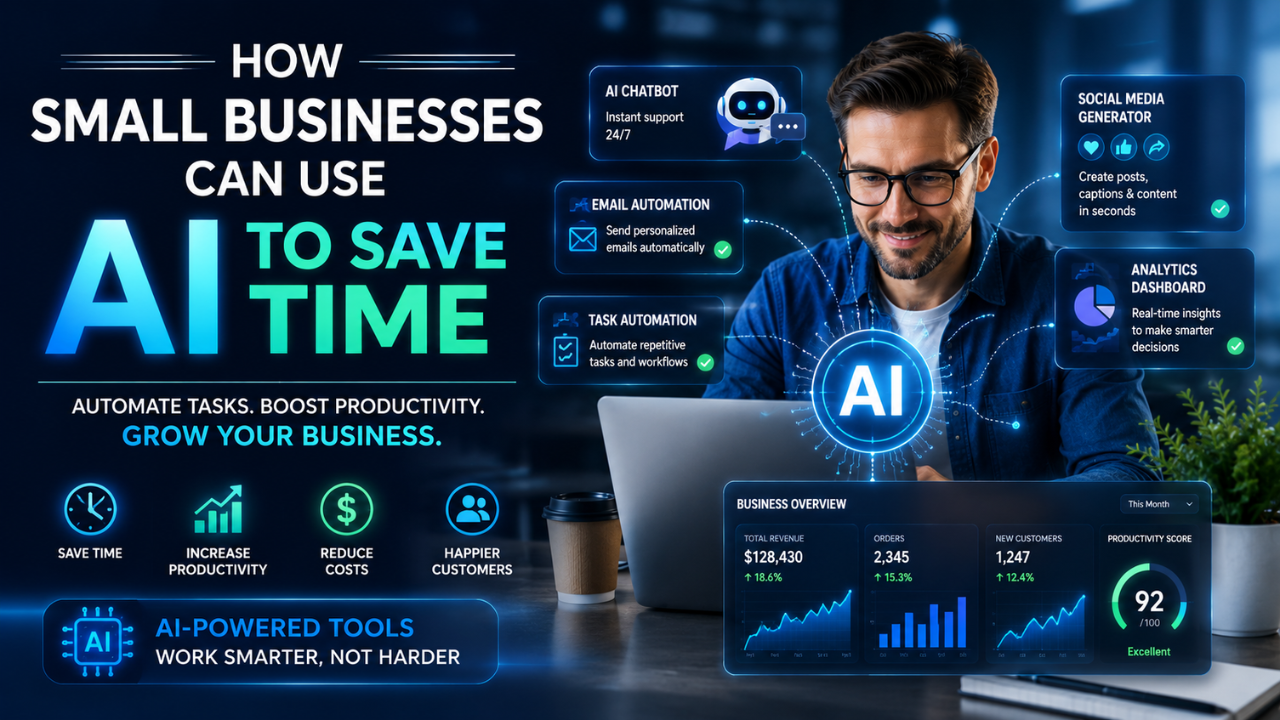
Artificial intelligence (AI) is no longer just a buzzword or a technology reserved for large corporations with massive budgets. In 2026, AI has become an affordable and practical solution for businesses of all sizes, especially small businesses looking to improve productivity, reduce operating costs, and compete in an increasingly digital marketplace. From automating repetitive tasks to enhancing customer service and streamlining marketing efforts, AI is transforming the way entrepreneurs run their companies.
For many small business owners, time is the most valuable resource. Managing emails, scheduling appointments, creating marketing content, responding to customers, tracking finances, and organizing daily operations can consume hours every week. Fortunately, AI-powered tools can automate many of these repetitive tasks, allowing business owners to focus on strategic decisions, customer relationships, and business growth.
Whether you own a local retail shop, an e-commerce store, a restaurant, a consulting firm, or a service-based business, AI can help you work smarter instead of harder. Today’s AI tools are user-friendly, affordable, and designed to integrate seamlessly into existing workflows, making them accessible even for entrepreneurs without technical expertise.
In this comprehensive guide, you’ll discover how small businesses can use AI to save time, improve efficiency, and increase profitability. We’ll explore practical applications of AI, the best areas to automate, common mistakes to avoid, and future trends that every entrepreneur should understand.
Why Time Management Is Critical for Small Businesses
Running a small business often means wearing multiple hats. On any given day, you might be acting as the CEO, marketer, accountant, customer service representative, and salesperson—all at the same time. While this flexibility is one of the strengths of small businesses, it can also become a major obstacle to growth.
Many business owners spend more time handling administrative tasks than developing new products, finding customers, or improving their services. Over time, these repetitive activities can lead to burnout and limit business expansion.
Some of the most common time-consuming tasks include:
- Answering customer emails
- Scheduling appointments
- Managing social media accounts
- Creating invoices
- Bookkeeping
- Data entry
- Inventory management
- Writing marketing content
- Responding to frequently asked questions
- Preparing reports
Artificial intelligence can automate many of these responsibilities, freeing up valuable hours each week and allowing entrepreneurs to focus on activities that generate revenue.
What Is Artificial Intelligence?
Artificial intelligence refers to computer systems that can perform tasks typically requiring human intelligence. Unlike traditional software that follows fixed rules, AI can analyze data, recognize patterns, learn from experience, and improve over time.
Modern AI uses technologies such as:
Machine Learning
Machine learning enables software to learn from historical data and improve predictions without being explicitly programmed for every scenario.
Natural Language Processing (NLP)
NLP allows AI to understand, interpret, and generate human language, making it possible to create chatbots, writing assistants, and virtual customer service agents.
Computer Vision
Computer vision enables AI to recognize objects, faces, documents, and images, helping businesses automate visual inspections, inventory tracking, and quality control.
Predictive Analytics
Predictive AI analyzes past behavior to forecast future outcomes, helping businesses make smarter decisions about sales, inventory, and customer demand.
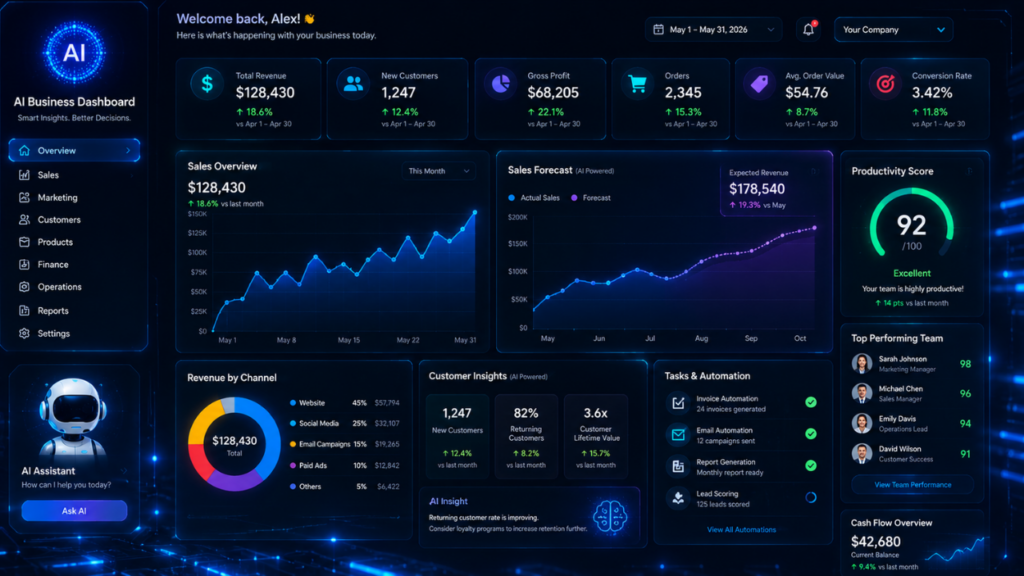
The Biggest Benefits of AI for Small Businesses
Save Hours Every Week
One of the most immediate advantages of AI is time savings.
Instead of manually completing repetitive tasks, AI performs them automatically and often much faster than humans.
Examples include:
- Generating invoices
- Scheduling appointments
- Organizing files
- Summarizing meetings
- Drafting emails
- Creating marketing content
Many business owners report saving several hours each week after implementing AI-powered automation.
Reduce Operating Costs
Hiring employees to perform repetitive administrative work can be expensive.
AI reduces labor costs by automating routine tasks while maintaining consistency and accuracy.
Although AI doesn’t replace human creativity or strategic thinking, it significantly reduces the workload associated with repetitive processes.
Increase Productivity
Employees spend less time on administrative work and more time serving customers, solving problems, and growing the business.
Rather than replacing staff, AI often enhances their capabilities by acting as a digital assistant.
Improve Customer Satisfaction
Modern consumers expect fast responses.
AI-powered customer service tools provide:
- Instant answers
- 24/7 support
- Appointment scheduling
- Order tracking
- Personalized recommendations
Faster service leads to happier customers and stronger loyalty.
How AI Automates Daily Administrative Tasks
Administrative work often consumes a significant portion of the workday.
AI can automate tasks such as:
- Calendar management
- Scheduling meetings
- Sending reminders
- Creating documents
- Organizing files
- Processing forms
- Data entry
- Document summaries
Instead of spending hours managing paperwork, business owners can devote their attention to higher-value activities.
For example, an AI scheduling assistant can coordinate meetings by checking everyone’s availability, sending invitations, and automatically updating calendars. This eliminates the back-and-forth emails typically required to arrange appointments.
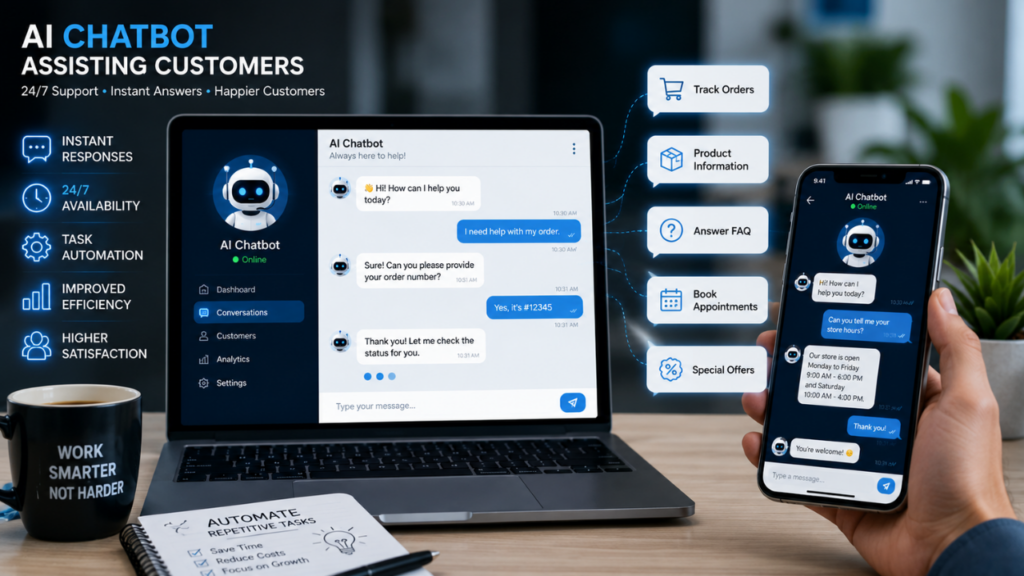
Using AI for Customer Service
Customer support is one of the areas where AI delivers the fastest return on investment.
AI Chatbots
AI chatbots are capable of answering common customer questions at any time of day.
They can assist customers with:
- Business hours
- Product information
- Order status
- Shipping updates
- Appointment booking
- Refund policies
This allows businesses to provide excellent customer service without hiring additional support staff.
More advanced AI chatbots can even recognize customer intent and escalate complex issues to a human representative when necessary.
AI Email Assistants
Managing customer emails can consume several hours every week.
AI email assistants help by:
- Drafting professional replies
- Prioritizing important messages
- Categorizing emails
- Suggesting responses
- Automatically answering routine inquiries
This improves response times while reducing administrative workload.
AI for Marketing Automation
Marketing is essential for business growth, but it can also be incredibly time-consuming.
AI makes marketing more efficient through automation and data analysis.
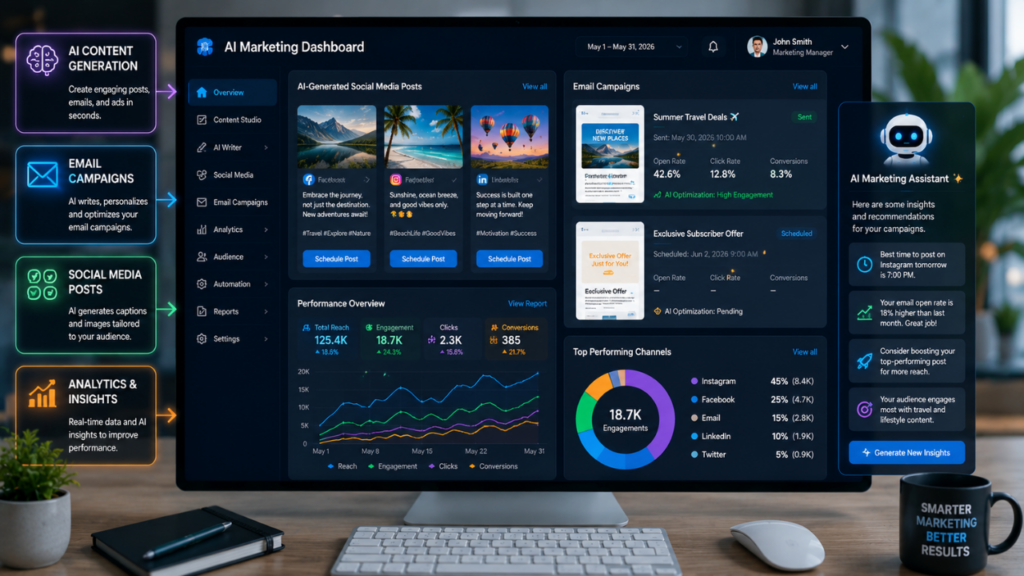
Content Creation
One of the most popular uses of AI is content generation.
AI writing assistants help businesses create:
- Blog posts
- Product descriptions
- Email newsletters
- Website copy
- Landing pages
- Social media captions
- Advertising copy
Rather than replacing human creativity, AI speeds up the writing process by producing high-quality first drafts that can be edited and personalized.
Social Media Management
Maintaining multiple social media platforms requires significant time.
AI tools can:
- Suggest content ideas
- Generate captions
- Schedule posts
- Analyze engagement
- Recommend hashtags
- Identify trending topics
This helps businesses maintain a consistent online presence with much less manual effort.
Personalized Marketing
Today’s AI platforms analyze customer behavior to deliver personalized recommendations.
Instead of sending the same promotional email to every subscriber, AI customizes messages based on:
- Previous purchases
- Browsing behavior
- Customer interests
- Purchase history
- Demographics
Personalization often leads to higher open rates, better engagement, and increased sales.
AI for Accounting and Financial Management
Bookkeeping is one of the least enjoyable—but most important—tasks for small business owners.
AI-powered accounting software can automate many financial processes, including:
- Expense categorization
- Invoice generation
- Payment reminders
- Cash flow forecasting
- Bank reconciliation
- Financial reporting
By reducing manual data entry, AI helps minimize errors and saves hours every month.
Some AI accounting platforms also provide financial insights in plain language, making it easier for business owners to understand their company’s financial health without requiring advanced accounting knowledge.
AI for Sales and Customer Relationship Management (CRM)
Generating leads and closing sales are essential for every small business, but manually tracking prospects and following up with customers can be time-consuming. AI-powered Customer Relationship Management (CRM) systems simplify the entire sales process by organizing customer information and automating routine tasks.
Lead Scoring
Not every lead is equally likely to become a customer. AI analyzes customer behavior, website visits, email interactions, and previous purchases to identify which leads have the highest chance of converting.
This allows sales teams to focus their efforts where they are most likely to see results.
Automated Follow-Ups
One of the biggest reasons businesses lose potential customers is inconsistent follow-up. AI can automatically:
- Send personalized emails
- Schedule reminders
- Recommend the best time to contact prospects
- Track customer interactions
- Alert sales teams when a lead is ready to buy
By automating these processes, businesses can improve conversion rates while spending less time managing contacts.
AI for Inventory Management
For businesses that sell physical products, inventory management can be challenging. Running out of stock can lead to lost sales, while overstocking ties up valuable cash.
AI helps by predicting demand based on factors such as:
- Historical sales
- Seasonal trends
- Customer purchasing habits
- Local events
- Weather conditions
- Market demand
With more accurate forecasts, businesses can reduce waste, improve cash flow, and ensure products are available when customers need them.
AI for Human Resources and Hiring
Hiring the right employees often requires reviewing dozens—or even hundreds—of resumes. AI-powered recruitment tools help streamline this process.
They can:
- Screen resumes based on job requirements
- Rank candidates
- Schedule interviews
- Generate interview questions
- Organize applicant information
This saves hiring managers significant time while helping them identify qualified candidates more efficiently.
AI can also assist with employee onboarding by creating training materials, answering common HR questions, and tracking required documentation.
AI Meeting Assistants
Meetings often generate valuable information, but taking notes and organizing action items can be tedious.
AI meeting assistants can:
- Record virtual meetings
- Generate accurate transcripts
- Summarize discussions
- Highlight key decisions
- Create task lists
- Assign follow-up actions
Instead of spending time writing notes, participants can focus on the conversation while AI handles the documentation.
AI for Cybersecurity
Cybersecurity threats continue to increase each year, and small businesses are frequent targets because they often have fewer security resources than large organizations.
AI enhances cybersecurity by identifying suspicious behavior before it becomes a serious problem.
Examples include:
- Detecting unusual login attempts
- Monitoring network activity
- Identifying phishing emails
- Recognizing malware
- Flagging fraudulent transactions
Because AI can analyze thousands of events every second, it often detects threats much faster than traditional security systems.
AI for Data Analysis and Business Intelligence
Small businesses generate large amounts of valuable data every day. Sales figures, customer feedback, website analytics, and marketing performance all contain insights that can guide smarter decisions.
AI-powered analytics tools transform raw data into easy-to-understand reports by:
- Identifying trends
- Forecasting future sales
- Measuring marketing performance
- Tracking customer behavior
- Recommending improvements
Instead of spending hours analyzing spreadsheets, business owners receive actionable insights within minutes.
Real-World Examples of AI Saving Time
Local Coffee Shop
A neighborhood coffee shop uses AI to:
- Forecast inventory
- Schedule employee shifts
- Respond to online customer inquiries
- Manage loyalty rewards
As a result, the owner spends less time on administrative work and more time improving customer experience.
Online Clothing Store
An e-commerce retailer uses AI to:
- Recommend products
- Write product descriptions
- Answer customer questions
- Optimize email marketing campaigns
- Predict inventory demand
This improves customer satisfaction while reducing manual work.
Marketing Agency
A small digital marketing agency relies on AI to:
- Draft blog articles
- Generate social media captions
- Create email campaigns
- Analyze campaign performance
- Produce meeting summaries
The team completes projects faster and can serve more clients without increasing staff.
Common Mistakes to Avoid When Using AI
Although AI offers tremendous benefits, businesses should avoid relying on it without proper oversight.
Expecting AI to Do Everything
AI is an assistant—not a replacement for business owners or employees. Human creativity, strategic thinking, and relationship-building remain essential.
Use AI to automate repetitive work while allowing people to focus on high-value activities.
Ignoring Data Privacy
Businesses should carefully protect customer information and ensure AI tools comply with applicable privacy laws.
Always review how your chosen software stores, processes, and secures sensitive data.
Skipping Human Review
AI can occasionally make mistakes or generate inaccurate information.
Always review:
- Marketing content
- Customer communications
- Financial reports
- Legal documents
A quick human review helps maintain accuracy and professionalism.
Automating Too Much at Once
Introducing several AI systems simultaneously can overwhelm employees and disrupt operations.
Start with one or two processes, measure results, and expand gradually.
Best Practices for Implementing AI
To maximize success, follow these recommendations:
Start with Repetitive Tasks
Look for activities that consume time but require little creativity, such as scheduling, invoicing, or responding to common customer questions.
Train Your Team
Provide employees with training so they understand how to use AI effectively.
When employees feel comfortable with new technology, adoption becomes much smoother.
Measure Results
Track important metrics, including:
- Hours saved
- Customer satisfaction
- Sales growth
- Marketing performance
- Operational costs
Monitoring these indicators helps determine whether your AI investment is delivering value.
Keep Learning
Artificial intelligence evolves rapidly. Stay informed about new features and emerging technologies to ensure your business remains competitive.
Future Trends in AI for Small Businesses
Artificial intelligence continues to advance at an impressive pace. Several trends are expected to shape the future of small businesses.
AI Agents
AI agents are becoming more capable of managing complete workflows rather than performing isolated tasks. In the future, they may coordinate projects, communicate with customers, and automate entire business processes with minimal supervision.
Hyper-Personalization
Businesses will increasingly deliver highly personalized experiences based on customer preferences, browsing behavior, and purchase history.
Personalized marketing is expected to improve customer engagement and loyalty.
Voice AI
Voice assistants will continue improving, enabling businesses to automate phone support, appointment scheduling, and customer interactions using natural conversations.
Multimodal AI
Future AI systems will understand and combine text, images, audio, and video simultaneously, making them even more useful for marketing, design, education, and customer support.
Frequently Asked Questions
Can small businesses afford AI?
Yes. Many AI platforms offer affordable subscription plans, and some provide free versions suitable for startups and small businesses.
Do I need technical knowledge to use AI?
Most modern AI tools are designed for non-technical users with intuitive interfaces and simple setup processes.
Will AI replace employees?
AI is best viewed as a productivity tool. It automates repetitive tasks while allowing employees to focus on creative, strategic, and customer-facing work.
Which departments benefit most from AI?
Marketing, customer service, accounting, sales, inventory management, and administration are among the areas where AI delivers the greatest time savings.
Is AI secure?
Reputable providers invest heavily in security. However, businesses should still follow cybersecurity best practices, including strong passwords, employee training, and regular software updates.
Conclusion
Artificial intelligence is transforming the way small businesses operate, making it easier than ever to automate repetitive tasks, improve customer service, and make smarter decisions. What was once considered advanced technology for large corporations is now accessible to businesses of every size.
By using AI to handle administrative work, marketing, customer support, sales, accounting, and data analysis, entrepreneurs can save valuable time and focus on growing their businesses. Rather than replacing people, AI empowers teams to work more efficiently, reduce errors, and deliver better customer experiences.
The key to success is implementing AI strategically. Start with one or two areas where automation can have the biggest impact, measure your results, and gradually expand your use of AI as your business grows. Combining human expertise with artificial intelligence creates a powerful partnership that helps businesses stay competitive in an increasingly digital world.
For small businesses looking to increase productivity, reduce operating costs, and prepare for the future, adopting AI is no longer optional—it is becoming a critical part of long-term success.
Emily Carter
Technology Editor at GrowthPoweredAI
Emily Carter is a technology writer specializing in artificial intelligence, automation, future technology trends, and digital innovation. She researches the latest AI tools, emerging technologies, and business automation strategies to help readers understand how technology is shaping the future. Through in-depth research and practical insights, Emily creates informative content designed for entrepreneurs, professionals, and technology enthusiasts. Read more articles by Emily on GrowthPoweredAI.