Introduction
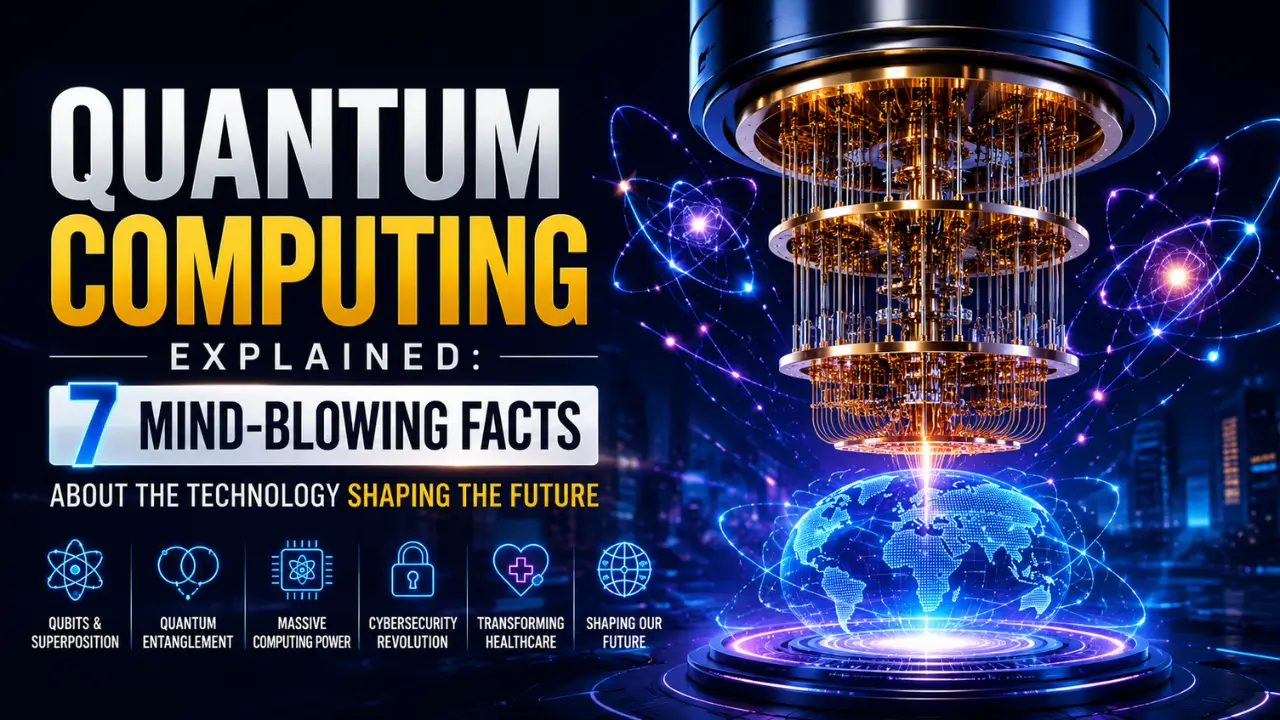
Quantum computing is one of the most exciting and revolutionary technologies of the 21st century. While traditional computers have transformed the world through incredible processing power, quantum computers promise to solve problems that would take today’s most advanced supercomputers thousands or even millions of years to complete.
From accelerating drug discovery to improving artificial intelligence and cybersecurity, quantum computing has the potential to reshape entire industries. Major technology companies such as IBM, Google, Microsoft, and numerous startups are investing billions of dollars into quantum research, believing that the technology could become as important as the internet itself.
But what exactly is quantum computing? How does it work, and why is everyone talking about it?
In this guide, we’ll break down quantum computing in simple terms and explore the seven essential facts you need to understand this groundbreaking technology.
What Is Quantum Computing?
Quantum computing is a new type of computing that uses the principles of quantum mechanics—the science that explains how particles behave at the atomic and subatomic levels.
Traditional computers process information using bits. A bit can only be one of two values:
- 0
- 1
Every website, photo, video, application, and file on your computer is ultimately represented using these binary digits.
Quantum computers, however, use quantum bits, or qubits. Unlike classical bits, qubits can exist in multiple states simultaneously due to a phenomenon known as superposition.
This unique capability allows quantum computers to process enormous amounts of information at once, making them potentially far more powerful than traditional computers for certain tasks.
Fact #1: Quantum Computers Use Qubits Instead of Bits
The most fundamental difference between classical and quantum computing is the way information is stored.
Classical Computing
A classical bit is either:
- 0
- 1
There is no middle ground.
Quantum Computing
A qubit can be:
- 0
- 1
- Both 0 and 1 simultaneously
This concept may seem impossible from our everyday perspective, but it is a natural property of quantum particles.
Imagine a coin.
A classical bit is like a coin lying flat on a table showing either heads or tails.
A qubit is like a spinning coin that exists in a combination of heads and tails until you observe it.
This ability dramatically increases computational possibilities.
Fact #2: Superposition Creates Massive Processing Power
Superposition is one of the key principles that makes quantum computing so powerful.
When multiple qubits work together, they can represent many possible solutions simultaneously.
For example:
- 1 qubit can represent 2 states
- 2 qubits can represent 4 states
- 10 qubits can represent 1,024 states
- 50 qubits can represent over 1 quadrillion states
This exponential growth allows quantum computers to explore vast numbers of possibilities at the same time.
Why It Matters
Many real-world problems involve evaluating millions or billions of possible outcomes.
Examples include:
- Finding the fastest delivery route
- Predicting financial markets
- Designing new materials
- Modeling chemical reactions
A sufficiently advanced quantum computer could analyze these possibilities far more efficiently than conventional computers.
Fact #3: Quantum Entanglement Enables Extraordinary Capabilities
Another critical concept in quantum computing is entanglement.
Entanglement occurs when two or more quantum particles become linked in such a way that the state of one particle instantly influences the state of another.
Even if they are separated by large distances, the particles remain connected.
How Entanglement Helps Quantum Computers
Entangled qubits can coordinate with one another in ways that classical bits cannot.
This enables:
- Faster computations
- Enhanced problem-solving
- More efficient information processing
Scientists often describe entanglement as one of the strangest and most fascinating aspects of quantum physics.
Without entanglement, quantum computing would lose much of its computational advantage.
Fact #4: Quantum Computers Are Not Faster at Everything
One common misconception is that quantum computers will replace traditional computers entirely.
This is not true.
Quantum computers are specialized machines designed for specific types of problems.
For everyday tasks such as:
- Browsing the internet
- Streaming videos
- Sending emails
- Using spreadsheets
Traditional computers remain the better option.
Where Quantum Computers Excel
Quantum computers are particularly effective at:
Optimization Problems
Finding the best solution among countless possibilities.
Examples:
- Airline scheduling
- Traffic management
- Supply chain optimization
Scientific Simulations
Modeling molecules and chemical reactions with incredible accuracy.
Cryptography
Analyzing encryption systems and security protocols.
Artificial Intelligence
Improving machine learning algorithms and data analysis.
The future will likely involve quantum and classical computers working together rather than one replacing the other.
Fact #5: Quantum Computing Could Revolutionize Healthcare
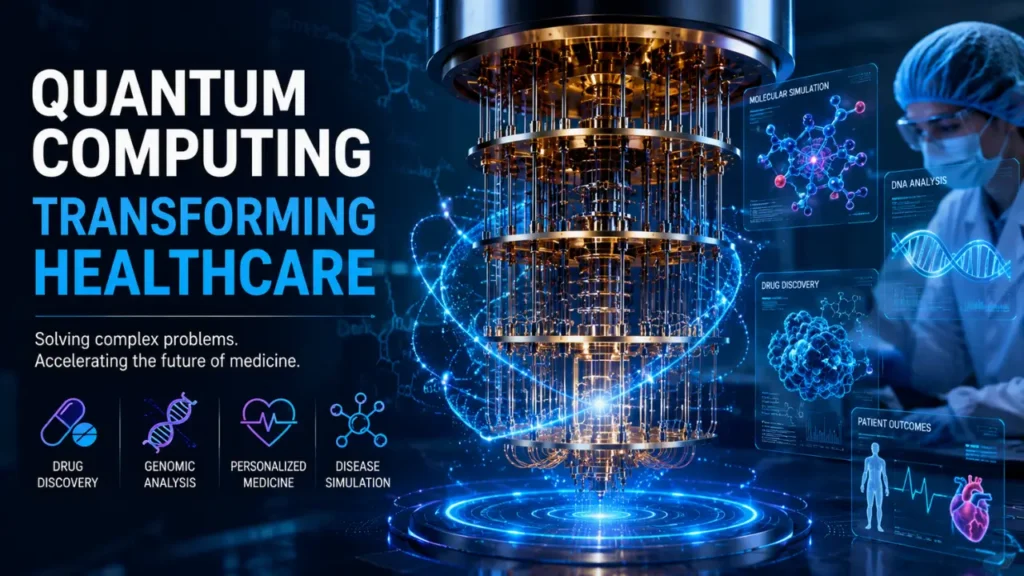
One of the most promising applications of quantum computing is healthcare.
Developing new medicines is an expensive and time-consuming process.
Researchers often spend years simulating molecular interactions to determine whether a drug candidate might be effective.
Why Quantum Computing Matters
Since molecules naturally follow quantum mechanical rules, quantum computers are uniquely suited to simulate them.
Potential benefits include:
- Faster drug discovery
- Personalized medicine
- Better disease modeling
- Improved medical research
Scientists believe quantum computing could significantly accelerate the development of treatments for diseases such as:
- Cancer
- Alzheimer’s disease
- Parkinson’s disease
- Rare genetic disorders
This capability alone could transform modern healthcare.
Fact #6: Quantum Computing Could Change Cybersecurity Forever
Cybersecurity is another area where quantum computing could have a profound impact.
Today’s encryption methods protect:
- Bank accounts
- Online shopping
- Emails
- Government communications
Most current encryption systems rely on mathematical problems that are extremely difficult for classical computers to solve.
The Quantum Threat
Advanced quantum computers may eventually be able to solve some of these problems much faster.
This could potentially break certain encryption methods currently used worldwide.
The Solution: Quantum-Safe Encryption
Researchers are already developing new forms of encryption designed to resist quantum attacks.
This emerging field is called:
Post-Quantum Cryptography
Governments and technology companies around the world are actively preparing for the quantum era by developing stronger security standards.
While the threat is still years away, preparation has already begun.
Fact #7: We Are Still in the Early Stages of Quantum Computing
Despite all the excitement, quantum computing is still in its infancy.
Current quantum computers face significant challenges.
Quantum Decoherence
Qubits are extremely sensitive to their environment.
Even tiny disturbances can cause errors and disrupt calculations.
Error Correction
Quantum systems are prone to mistakes, making reliable computation difficult.
Scalability
Building large quantum computers with thousands or millions of stable qubits remains a major engineering challenge.
High Costs
Quantum systems often require specialized environments, including temperatures colder than outer space.
Because of these challenges, today’s quantum computers are still experimental.
However, progress is happening rapidly.
Major Companies Leading the Quantum Computing Race
Several organizations are investing heavily in quantum technology.
IBM
IBM has developed multiple quantum processors and offers cloud access to quantum systems for researchers and developers.
Google gained worldwide attention after claiming quantum supremacy—a milestone where a quantum computer performed a task faster than a traditional supercomputer.
Microsoft
Microsoft is developing quantum software platforms and researching advanced qubit technologies.
Amazon
Amazon provides cloud-based quantum computing services through Amazon Braket.
Intel
Intel continues to develop scalable quantum hardware solutions.
Startups Driving Innovation
Numerous startups are also contributing to the field, including:
- IonQ
- Rigetti Computing
- D-Wave
- PsiQuantum
These companies are helping accelerate the commercialization of quantum technology.
Real-World Applications of Quantum Computing
Although quantum computing is still developing, many potential applications are already being explored.
Financial Services
Banks could use quantum algorithms to:
- Optimize portfolios
- Analyze risk
- Detect fraud
Logistics
Companies may improve:
- Shipping routes
- Inventory management
- Delivery schedules
Climate Research
Quantum simulations could help scientists better understand:
- Climate change
- Weather systems
- Renewable energy solutions
Artificial Intelligence
Quantum machine learning may lead to:
- Faster data processing
- Improved predictions
- More advanced AI systems
Materials Science
Researchers could discover new materials for:
- Batteries
- Solar panels
- Electronics
- Aerospace engineering
The possibilities continue to grow as technology advances.
Challenges That Still Need to Be Solved
Despite impressive progress, several obstacles remain.
Hardware Limitations
Current quantum computers have relatively few reliable qubits.
Noise and Errors
Quantum systems remain highly vulnerable to interference.
Cost
Developing and maintaining quantum hardware is expensive.
Talent Shortage
Quantum computing requires expertise in:
- Physics
- Computer science
- Mathematics
- Engineering
The industry needs more trained professionals to support future growth.
These challenges will likely take years to overcome.
The Future of Quantum Computing
Experts believe quantum computing could eventually become as transformative as:
- The internet
- Smartphones
- Artificial intelligence
- Cloud computing
In the coming decades, we may see:
- Practical quantum applications
- Commercial quantum services
- Quantum-enhanced AI systems
- Revolutionary scientific discoveries
Some experts predict that quantum computing could unlock solutions to problems that humanity currently considers impossible.
While widespread adoption may still be years away, the foundation for the quantum future is already being built.
How to Learn Quantum Computing as a Beginner
As interest in quantum computing continues to grow, many students, developers, and technology enthusiasts are wondering how they can get started in this fascinating field. The good news is that learning quantum computing has become more accessible than ever thanks to online courses, cloud-based quantum platforms, and educational resources provided by major technology companies.
The first step is understanding the basics of quantum mechanics. While you don’t need a Ph.D. in physics to begin, having a foundational understanding of concepts such as superposition, entanglement, and quantum states can make learning quantum computing much easier.
Next, it helps to build a strong foundation in mathematics and computer science. Topics such as linear algebra, probability, and programming play important roles in quantum algorithms and quantum software development.
Several companies now offer free access to real quantum computers through the cloud. Platforms like IBM Quantum allow users to experiment with actual quantum processors and learn how quantum circuits work in a hands-on environment. This practical experience can help beginners move beyond theory and understand the real-world challenges of quantum computing.
There are also programming frameworks specifically designed for quantum development. Popular examples include Qiskit, Cirq, and Microsoft’s Quantum Development Kit. These tools enable developers to create and test quantum algorithms without owning expensive quantum hardware.
As industries continue investing heavily in quantum technology, the demand for skilled professionals is expected to rise significantly over the next decade. Careers in quantum computing may include roles such as quantum software engineer, quantum researcher, quantum hardware specialist, and quantum algorithm developer.
For anyone interested in the future of technology, learning quantum computing today could provide valuable skills and open doors to exciting opportunities in one of the world’s fastest-growing fields.
Conclusion
Quantum computing represents one of the most significant technological breakthroughs of our time. By harnessing the principles of quantum mechanics, these machines can process information in fundamentally different ways from traditional computers.
The power of qubits, superposition, and entanglement gives quantum computers the potential to revolutionize fields such as healthcare, cybersecurity, finance, artificial intelligence, and scientific research.
Although the technology remains in its early stages, rapid progress from companies like IBM, Google, Microsoft, and emerging startups suggests that the quantum era is approaching faster than many people realize.
Understanding quantum computing today is similar to understanding the internet in its earliest days. The technology may seem complex now, but its impact on society could be enormous in the years ahead.
As research continues and practical applications emerge, quantum computing may become one of the defining innovations of the future.
Interested in discovering how artificial intelligence is transforming the world? Check out our latest articles on https://growthpoweredai.com/2026/06/15/agi-explained-for-beginners/