Artificial intelligence is no longer limited to writing text, creating images, or answering questions. A new generation of AI systems is learning to interpret one of the most complex languages in existence: the genetic code of life. Evo 1 and Evo 2 are genomic foundation models created to analyze biological sequences at an extraordinary scale, giving scientists new ways to study DNA, RNA, proteins, mutations, and complete genomes.
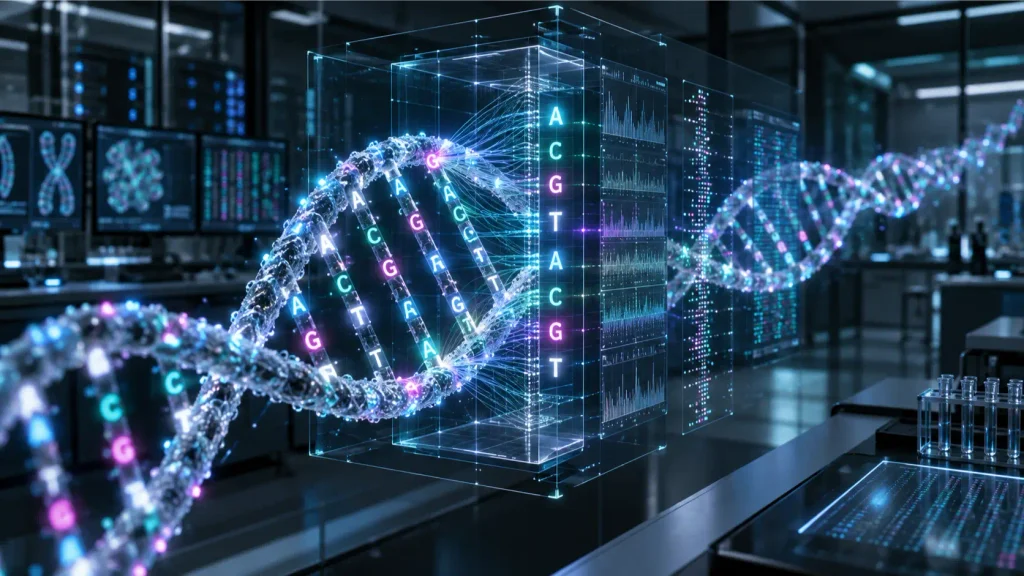
These models work somewhat like large language models, but instead of training primarily on books, websites, and conversations, they learn patterns from genomic sequences. DNA contains combinations of the nucleotide bases adenine, cytosine, guanine, and thymine, usually represented by the letters A, C, G, and T. Through training on enormous collections of these sequences, Evo can learn statistical relationships that reflect biological structure and function.
The original Evo model—often informally called Evo 1 following the arrival of its successor—demonstrated that a general AI system could perform biological prediction and generation tasks across long stretches of DNA. Evo 2 expanded that idea dramatically by using a much larger and more diverse training collection representing organisms from across the tree of life.
The result is a technology that could help researchers investigate genetic variation, understand disease-related mutations, develop gene-editing tools, and explore entirely new forms of biological design. However, its predictions are not guaranteed facts, and sequences proposed by the model still require extensive laboratory testing and safety evaluation.
This article explains what Evo 1 and Evo 2 are, how they work, what separates the two generations, and why these AI models could become important tools in the future of biology.
What Are Evo 1 and Evo 2?
Evo 1 and Evo 2 are biological foundation models designed to understand and generate genomic sequences. They were developed through collaborations involving the Arc Institute and academic and technology researchers. The first model involved researchers from the Arc Institute, Stanford University, and Together AI. Evo 2 was developed through a broader collaboration that included the Arc Institute, NVIDIA, Stanford University, the University of California, Berkeley, and other contributors.
A foundation model is a large AI model trained on a broad dataset so that it can later perform many different tasks. ChatGPT is an example of the general concept in human language: after learning patterns in text, it can summarize, translate, explain, and generate new writing. Evo applies a related principle to biology.
Instead of predicting the next word in a sentence, a genomic language model can predict the next nucleotide in a DNA sequence. This seemingly simple training objective can allow the model to learn complicated biological patterns, including signals associated with genes, regulatory regions, RNA, and protein-coding sequences.
Importantly, Evo does not understand life in the same conscious or experimental sense as a human scientist. It identifies mathematical patterns in genetic data. Those patterns can nevertheless be useful for prediction, hypothesis generation, and biological design.
What Is Evo 1?
The original Evo model was introduced in 2024 and published in the journal Science. Although its official name was simply Evo, it is now commonly distinguished from the second generation as Evo 1.
Evo 1 contains approximately 7 billion parameters and was trained on OpenGenome, a dataset containing around 300 billion nucleotides from approximately 2.7 million prokaryotic and bacteriophage genomes. Prokaryotes include organisms such as bacteria and archaea, while bacteriophages are viruses that infect bacteria.
The model processes genomic information at single-nucleotide resolution. In other words, it examines individual DNA letters instead of grouping many nucleotides into larger units. This level of precision is especially important because changing a single nucleotide can sometimes alter a protein, affect gene regulation, or contribute to disease.
Evo 1 uses an architecture called StripedHyena, which combines attention mechanisms with signal-processing techniques designed to handle very long sequences more efficiently than a conventional Transformer. Its original context length was approximately 131,000 nucleotides, allowing it to analyze genetic relationships across much longer distances than many earlier DNA models.
What Can Evo 1 Do?
Evo 1 demonstrated several important capabilities:
- Predicting how mutations may affect biological function
- Examining protein-coding DNA, noncoding RNA, and regulatory sequences
- Predicting which genes may be essential for an organism’s survival
- Generating combinations of biological components
- Proposing novel CRISPR-Cas systems
- Designing transposable genetic systems
- Producing long, genome-like sequences rich in potential genes
One particularly important achievement involved biological design. CRISPR systems contain multiple components, including proteins and RNA, that must function together. The research showed that Evo could propose coordinated sequences rather than working with only one isolated protein or gene. Follow-up experimental work reported a functional gene-editing system designed with the model, demonstrating that at least some AI-generated biological designs could operate in laboratory conditions.
This did not mean Evo could freely create fully functional organisms. It showed that a genomic foundation model could learn relationships between multiple biological components and generate promising candidates for scientists to test.
What Is Evo 2?
Evo 2 is the next generation of the genomic foundation-model project. It was announced in 2025, and peer-reviewed research describing it was published in Nature in 2026. The model significantly expanded the scale, diversity, and biological reach of Evo 1.
The largest original version of Evo 2 contains 40 billion parameters. It was trained on roughly 9 trillion DNA base pairs drawn from more than 100,000 species. Its OpenGenome2 training collection includes sequences representing organisms across all major domains of life, including prokaryotes and eukaryotes.
Eukaryotes include animals, plants, fungi, and humans. Their genomes are usually larger and more structurally complicated than bacterial genomes. They contain extensive noncoding regions, regulatory elements, chromosomes, and long-distance interactions that can influence when and where genes become active.
Evo 2 can process a context of up to approximately 1 million nucleotides at single-base resolution. That longer context gives the model an opportunity to detect relationships across large genomic regions rather than evaluating only a short, isolated sequence.
Evo 2 uses an updated architecture called StripedHyena 2. Like its predecessor, this architecture is designed to scale efficiently across long sequences while maintaining the fine resolution needed to identify individual genetic changes.
Why Evo 2 Is a Major Advancement
The greatest improvement is not simply that Evo 2 is larger. Its training data are far more diverse. Evo 1 concentrated on prokaryotes and bacteriophages, whereas Evo 2 learned from genomes representing a much broader portion of life on Earth.
That difference matters because biological rules do not operate identically in every organism. A model trained mainly on bacteria may learn valuable principles of genes and proteins but remain less useful for understanding the complex regulatory structure of a human genome. By including eukaryotic data, Evo 2 becomes more relevant to areas such as human genetics, rare diseases, agriculture, and complex cellular regulation.
Evo 2 can evaluate both coding variants, which occur in regions that provide instructions for proteins, and noncoding variants, which occur outside those protein-coding regions. Noncoding DNA represents most of the human genome and can influence gene activation, timing, cellular identity, and many other processes.
Evo 1 vs. Evo 2: Key Differences
| Feature | Evo 1 | Evo 2 |
| Introduction | 2024 | Announced in 2025; peer-reviewed publication in 2026 |
| Largest original model | 7 billion parameters | 40 billion parameters |
| Training scale | Around 300 billion nucleotides | Roughly 9 trillion DNA base pairs |
| Genomic sources | About 2.7 million prokaryotic and phage genomes | More than 100,000 species across the tree of life |
| Context length | Approximately 131,000 nucleotides | Up to approximately 1 million nucleotides |
| Architecture | StripedHyena | StripedHyena 2 |
| Main biological reach | Bacteria, archaea, and bacteriophages | Prokaryotic and eukaryotic organisms |
| Human-genome relevance | Limited | Substantially greater |
| Resolution | Single nucleotide | Single nucleotide |
The comparison shows why Evo 2 is more than a routine software update. It extends genomic modeling from a largely microbial domain toward a general system capable of studying the complexity and diversity of life.
How Do Genomic AI Models Work?
DNA can be treated as a sequence, but it is not merely random text. Patterns within it encode proteins, regulate gene activity, create structural features, and reflect billions of years of evolution. During training, Evo examines enormous numbers of genetic sequences and repeatedly attempts to predict what comes next.
When its predictions are wrong, the model’s internal parameters are adjusted. After countless examples, the model becomes better at recognizing patterns that regularly appear in real genomes.
This process can enable several kinds of tasks.
Sequence Prediction
The model calculates which nucleotide is statistically likely to appear next or which sequences are consistent with the surrounding genomic context. This fundamental ability supports more complex predictions.
Mutation Analysis
Researchers can compare how plausible a normal sequence appears to the model against a version containing a mutation. A major change in the model’s assessment may suggest that the mutation disrupts an important biological pattern.
This is not a clinical diagnosis. It is a computational signal that can help researchers prioritize variants for deeper analysis.
Biological Generation
Like a text model that generates a new paragraph, Evo can generate new DNA sequences. Scientists may guide the system with an existing sequence or biological objective and ask it to propose possible continuations or designs.
Generated DNA must be evaluated with computational filters, biosafety reviews, and laboratory experiments. A sequence that appears convincing mathematically may still fail to function in a cell or could produce unintended consequences.
Long-Range Genomic Reasoning
Some biological effects depend on elements separated by thousands of nucleotides. A large context window allows Evo to consider more of these distant relationships simultaneously. Evo 2’s million-base context is particularly valuable for studying large genes, regulatory neighborhoods, and genome-scale organization.
9 Powerful Ways Evo 1 and Evo 2 Could Transform Biology

1. Improving the Interpretation of Genetic Mutations
Sequencing a person’s genome can reveal millions of variants, but identifying which ones matter is extremely difficult. Evo 2 can help score variants by examining how well they fit the patterns learned from evolution and genomic context.
This could assist researchers studying rare diseases or inherited conditions. However, model predictions should be combined with clinical evidence, population data, family history, laboratory experiments, and expert interpretation.
2. Accelerating the Study of Noncoding DNA
Traditional genetic research often emphasizes protein-coding genes, even though they represent only a small portion of the human genome. Much of the remaining DNA helps regulate when, where, and how strongly genes are expressed.
Because Evo 2 is trained at single-nucleotide resolution across long sequences, it may help reveal patterns within these poorly understood noncoding regions. Better interpretation of regulatory DNA could improve scientists’ understanding of development, disease, and cellular behavior.
3. Supporting New Gene-Editing Tools
Evo 1 demonstrated the ability to generate multicomponent CRISPR-related systems. Future genomic models may help scientists explore gene-editing mechanisms beyond those already found and characterized in nature.
Rather than searching only through known organisms for useful molecular tools, researchers could use AI to propose candidates and then test them experimentally. This could expand the range, accuracy, or flexibility of genome-editing technologies.
4. Advancing Protein and RNA Research
DNA contains the instructions used to produce RNA and proteins. By learning from entire genomes, Evo can capture relationships across these biological layers.
Potential applications include predicting the effects of mutations, finding functional motifs, studying noncoding RNA, and proposing sequences with desired properties. Dedicated protein models may remain better for certain specialized tasks, but Evo’s advantage is its unified view of DNA, RNA, and proteins in their genomic context.
5. Making Biological Research More Efficient
Laboratory experiments can take months or years and require significant funding. AI cannot replace those experiments, but it can help researchers select the most promising possibilities before committing resources.
If thousands of mutations or candidate sequences are available, Evo may help rank them. Scientists can then focus laboratory work on a smaller set of high-value candidates, potentially reducing time and cost.
6. Helping Scientists Understand Evolution
Evo 2’s training data cover species from across the tree of life. The model can therefore identify genetic patterns that have been conserved, modified, or reinvented through evolution.
These patterns may reveal which parts of a sequence are essential and which tolerate variation. They may also help researchers study how biological systems adapt to different environments.
7. Enabling AI-Assisted Genome Design
One of the project’s most ambitious possibilities is genome-scale design. Evo models can generate extremely long sequences containing structures resembling those in natural genomes.
Nevertheless, generating a genome-like sequence is not equivalent to creating a viable organism. Life depends on complex interactions among genes, cells, environmental conditions, metabolism, and development. Genome design remains an experimental field that requires extensive validation and oversight.
8. Creating Opportunities in Agriculture and Sustainability
Genomic AI could eventually contribute to more resilient crops, improved microorganisms, sustainable materials, and environmental biotechnology. Researchers might use these models to investigate genetic traits connected to disease resistance, temperature tolerance, nutrient use, or useful biological production.
These applications are potential directions rather than guaranteed outcomes. Agricultural systems are complex, and any engineered organism would require careful environmental, regulatory, and safety assessment.
9. Contributing to Future Drug Discovery
Evo 1 and Evo 2 are not drug-discovery systems in the same way as specialized models designed to screen chemical compounds. Their contribution may occur earlier in the research process by helping scientists understand disease mechanisms, genetic targets, proteins, and regulatory pathways.
Better biological understanding can reveal promising therapeutic targets. In the long term, combining genomic foundation models with protein-structure prediction, molecular simulation, and laboratory automation could create more integrated AI-assisted research platforms.
Limitations of Evo 1 and Evo 2
Despite their impressive capabilities, Evo 1 and Evo 2 have important limitations.
First, they learn correlations from existing genomic data. A strong statistical pattern does not automatically prove a biological mechanism. Second, training data can contain errors, biases, missing species, and uneven representation. The model may perform better for organisms or sequence types that are well represented in its dataset.
Third, genomic context alone does not capture everything that occurs in a living organism. Gene activity is affected by cell type, development, environment, epigenetics, molecular concentrations, and interactions that may not be fully represented by DNA sequence.
Fourth, generated sequences may appear realistic without functioning as intended. Laboratory validation remains indispensable. Finally, powerful biological design tools raise biosecurity and ethical concerns. Access controls, sequence screening, responsible publication practices, monitoring, and cooperation between scientists and policymakers will be necessary as the technology improves.
Could Evo 2 Create New Life?
Claims that Evo 2 can simply “create life” are misleading. The model can generate long DNA sequences and propose biological components, but producing a sequence on a computer is very different from building a living, self-sustaining organism.
A viable cell requires coordinated replication, metabolism, regulation, membranes, molecular machinery, and interactions with its environment. Scientists would have to synthesize the DNA, place it in an appropriate biological system, and determine whether it functions safely and predictably.
It is more accurate to describe Evo 2 as a genome modeling and design tool. It can help researchers explore possibilities within biological sequence space, but it does not remove the need for expert scientific judgment or experimental proof.
Are Evo 1 and Evo 2 Available to Researchers?
The developers have released code, model resources, and documentation supporting research use. However, running the largest versions requires substantial computing resources and specialized technical knowledge. Smaller Evo 2 variants make experimentation more accessible, but genomic modeling remains computationally demanding.
Open availability can accelerate scientific discovery because researchers can examine, test, and improve the models. At the same time, openness in biological AI requires responsible safeguards to reduce the possibility of misuse.
The Future of AI and Genomics
Evo 1 established that a single foundation model could analyze and generate biological information across DNA, RNA, proteins, and long genomic sequences. Evo 2 expanded that vision to vastly more data, longer contexts, and organisms across the tree of life.
Future models could combine genomic sequence data with gene-expression measurements, cell images, protein structures, medical information, and laboratory results. Such multimodal systems might provide a more complete view of how genetic instructions become biological behavior.
AI may also become increasingly connected to automated laboratories. A model could propose an experiment, robotic equipment could conduct it, and the resulting measurements could guide the next prediction. This iterative approach has the potential to accelerate research, but it must operate within strict scientific, ethical, and safety standards.
The most realistic future is not one in which AI replaces biologists. It is one in which scientists use AI to evaluate more possibilities, detect patterns that would otherwise remain hidden, and design better experiments.
Frequently Asked Questions About Evo 1 and Evo 2
Is Evo 1 the model’s official name?
The first model was officially introduced as Evo. People often call it Evo 1 to distinguish it from Evo 2.
Who created Evo 1 and Evo 2?
Evo originated from research involving the Arc Institute, Stanford University, and Together AI. Evo 2 was developed through a broader collaboration involving the Arc Institute, NVIDIA, Stanford, UC Berkeley, and additional contributors.
Is Evo 2 a chatbot?
No. Evo 2 is a genomic foundation model. It processes and generates biological sequences rather than conducting ordinary natural-language conversations.
What is the biggest difference between Evo 1 and Evo 2?
Evo 1 was trained mainly on prokaryotic and bacteriophage genomes. Evo 2 uses a vastly larger and more diverse dataset spanning organisms across the tree of life, providing stronger relevance to complex eukaryotic and human genomes.
Can Evo 2 diagnose genetic diseases?
Evo 2 can help researchers predict the possible effects of genetic variants, but it is not a replacement for clinical diagnosis, validated medical testing, or professional genetic counseling.
Can these models design DNA?
Yes. They can generate proposed DNA sequences and biological components. However, generated designs require screening, laboratory testing, and safety evaluation before researchers can determine whether they function.
Why is the context window important?
A larger context window allows the model to examine relationships across longer stretches of DNA. This matters because regulatory elements can influence genes located far away in a sequence.
Will Evo replace laboratory scientists?
No. Evo can generate predictions and candidates, but scientists are needed to design studies, interpret results, perform experiments, assess safety, and confirm whether predictions are biologically valid.
Conclusion
Evo 1 and Evo 2 represent an important step in the convergence of artificial intelligence and biology. Evo 1 showed that a large model trained on microbial genomes could analyze biological function and propose sophisticated genetic systems. Evo 2 expanded that foundation with a larger model, a million-base context window, and training data covering organisms from across the tree of life.
Their potential applications include genetic-variant interpretation, noncoding DNA research, gene-editing development, evolutionary analysis, agriculture, and genome design. Yet their outputs remain predictions and proposals—not verified biological truths. Laboratory experiments, ethical oversight, biosecurity protections, and regulatory review will remain essential.
The greatest value of these models may be their ability to help scientists ask better questions. By uncovering patterns in enormous genomic datasets and generating candidates that humans might never consider, Evo can make biological exploration faster and broader. If developed responsibly, genomic AI could become one of the most powerful scientific tools of the coming decades.ks throughout the article rather than placing all of them in one section.
References
- Arc Institute. “Evo: DNA Foundation Modeling from Molecular to Genome Scale.”
- Nguyen, E. et al. “Sequence Modeling and Design from Molecular to Genome Scale with Evo.” Science.
- Arc Institute. “Evo 2: DNA Foundation Model.”
- Brixi, G. et al. “Genome Modelling and Design Across All Domains of Life with Evo 2.” Nature.
- NVIDIA. “AI for Biomolecular Sciences Now Available via NVIDIA BioNeMo.”