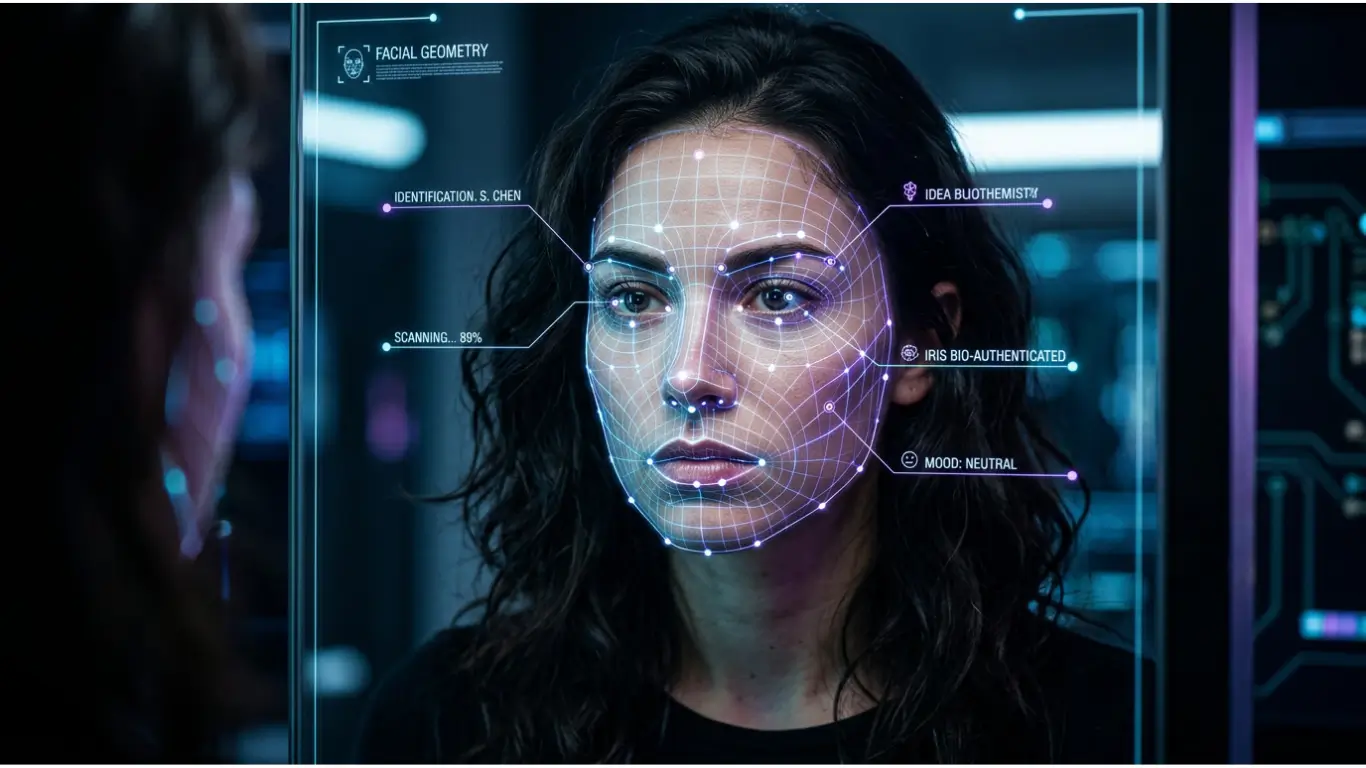
Artificial intelligence is moving beyond smartphones, computers, and business software. It is entering our homes, helping us manage daily routines, monitor wellness, and make more informed personal-care decisions. One of the most fascinating examples of this transformation is the Samsung Micro Led Beauty Mirror, an experimental smart mirror designed to analyze a user’s skin and deliver personalized beauty recommendations.
Samsung presented the device during its First Look 2025 event in Las Vegas, just before CES 2025. Rather than functioning as an ordinary reflective surface, the concept combines mirror technology, a digital display, a camera, artificial intelligence, and skincare data in one interactive device. Samsung says the display can analyze skin conditions and offer personalized beauty solutions. The concept also won the 2025 CES Best of Innovation award in the Beauty Tech category.
The Samsung Micro Led Beauty Mirror could signal an important change in the beauty industry. Instead of purchasing products mainly through advertisements, trends, or trial and error, consumers may eventually receive recommendations based on an AI assessment of their own skin. However, the technology also raises important questions about accuracy, privacy, bias, product marketing, and the difference between a cosmetic assessment and a medical diagnosis.
So, how does the Samsung beauty mirror work, what can it actually detect, and could it become part of our daily routines? Here is everything you need to know about this innovative fusion of artificial intelligence, display technology, and personalized skincare.
What Is the Samsung Micro Led Beauty Mirror?
The Samsung Micro Led Beauty Mirror is a 21-inch movable concept device that can operate as both a mirror and a smart display. The Consumer Technology Association, which runs the CES Innovation Awards, describes it as the world’s first Micro Led mirror display. Its specialized structure allows users to see a realistic reflection while digital information appears on the same surface.
This combination is important because many existing smart mirrors place a conventional screen behind reflective glass. Samsung’s concept aims to deliver the visual quality expected from an advanced display without losing the basic function of a mirror. According to a hands-on report from CES 2025, the prototype uses an aluminum-and-niobium micro-patterned mirror structure to balance reflection and light transmission.
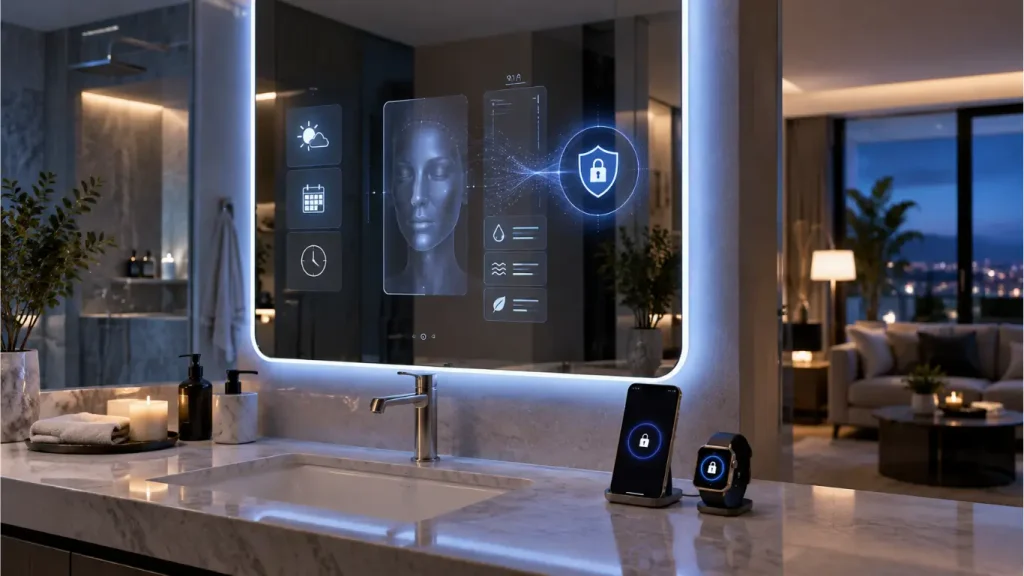
Beyond skincare, the mirror can display practical information such as the weather, a calendar, and a to-do list. The CES award description also says it includes Samsung smart-TV functions and AI optimizations. It may even consider a person’s schedule when offering makeup recommendations. These abilities turn the device into something closer to a personal beauty and information hub than a traditional bathroom mirror.
Its most attention-grabbing feature, however, is the AI Skin Report. A camera positioned above the display scans the user’s face. The system then evaluates visible characteristics and presents personalized insights on the mirror.
How the AI Skin Analysis Works
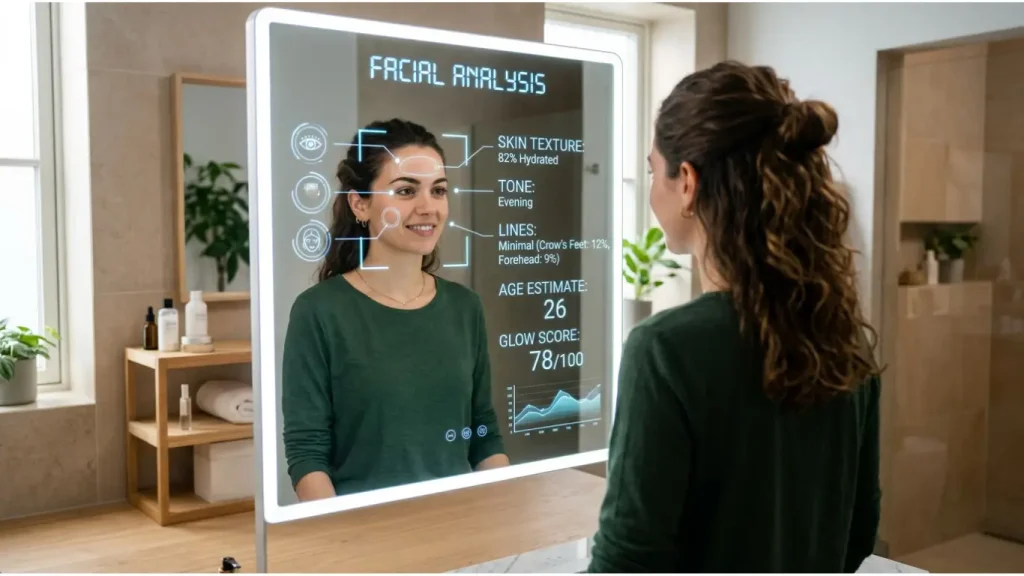
In the prototype demonstrated at CES 2025, a facial scan reportedly took approximately 30 seconds. The system evaluated four principal areas: wrinkles, pigmentation, pores, and redness, also known as erythema. It then produced a report explaining which concerns appeared most relevant to the user.
The artificial intelligence reportedly draws on information from approximately 20,000 clinically labeled, image-based skin diagnoses. In simple terms, the system was trained or developed using a large collection of skin images that had already been categorized by qualified experts. By comparing patterns in a new facial image with patterns represented in its reference data, the AI can estimate which characteristics may be present.
This does not mean the mirror thinks like a dermatologist. Image-analysis systems use mathematical models to identify visual patterns such as differences in color, texture, shape, and contrast. For example, an algorithm may estimate the visibility of pores by examining small changes in skin texture. It may assess pigmentation by identifying areas that appear darker than the surrounding skin or evaluate redness by measuring color variation across the face.
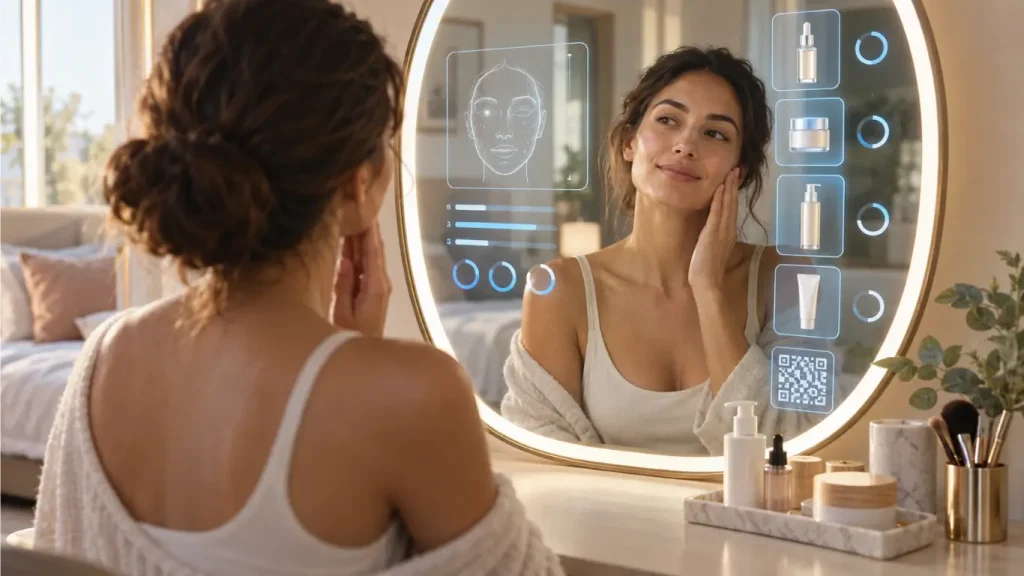
After completing its analysis, the mirror can suggest skincare products that correspond to the results. In the CES concept, recommendations came from Amorepacific, a major South Korean cosmetics company. A QR code could direct the user to a relevant product page, creating a direct connection between skin analysis, personalized advice, and shopping.
1. Personalized Skincare Could Become More Accessible
One of the strongest potential benefits of the Samsung Micro Led Beauty Mirror is personalization. The beauty market contains thousands of cleansers, moisturizers, serums, masks, and treatments. Packaging often includes terms such as hydrating, brightening, firming, soothing, or pore refining, but consumers may still struggle to determine what their skin actually needs.
An AI beauty led mirror could make the process easier by highlighting specific visible concerns. If the system detects noticeable dryness-related texture or redness, for example, it could prioritize gentle and moisturizing products instead of recommending an aggressive exfoliating treatment. If pigmentation appears to be the principal concern, it could suggest a different type of routine.
Personalization does not guarantee a perfect result, but it could give consumers a more useful starting point. This may be especially valuable for people who feel overwhelmed by skincare choices or repeatedly buy products that do not suit them.
2. The Mirror Could Help Users Track Changes Over Time
A single skin scan provides only a snapshot. The greater long-term value could come from comparing scans taken under consistent conditions over several weeks or months.
Imagine beginning a new skincare routine and using the mirror once a week. The system could potentially create a visual record of changes in redness, pigmentation, wrinkle visibility, or pore appearance. Instead of relying only on memory, users could review data and images to determine whether their routine appears to be helping.
Longitudinal tracking could also discourage constant product switching. Skincare products often need time to produce visible results, but consumers may abandon them too quickly because they cannot detect gradual changes. A well-designed tracking system might reveal small improvements that are difficult to notice from one day to the next.
Samsung has not publicly confirmed every future tracking function or the final software design. Nevertheless, historical comparison is a logical direction for this category of technology because AI becomes more useful when it can evaluate patterns over time rather than isolated images.
3. Micro Led Technology Creates a More Natural Experience
The display is not merely a decorative feature. It is central to the concept. Users need to see their reflection accurately while also viewing analysis results, instructions, product information, or makeup suggestions.
Micro Led displays use extremely small light-emitting diodes to produce an image. The technology is known for strong brightness, contrast, color performance, and durability. In the beauty mirror, Samsung combines display capabilities with high reflectance and transmittance so the device can behave like an everyday mirror while showing digital content.
This design could make the interaction feel more natural than opening a separate skincare app. Results can appear next to the relevant area of the face, and instructions could be displayed while the user applies a product. A future version might guide someone through the order of a morning routine, show a timer for a face mask, or demonstrate where a cosmetic product should be applied.
4. AI Could Reduce Some Skincare Guesswork
Many consumers select skincare through influencer videos, social-media trends, online reviews, or attractive packaging. These sources can introduce useful products, but they do not necessarily account for an individual’s skin.
AI analysis could bring more structure to the decision. Instead of beginning with the question, “Which product is popular?” the user could begin with, “Which visible issue am I trying to address?” This shift may lead to simpler, more intentional routines.
The word “could” is essential. A camera-based assessment depends on lighting, camera position, image quality, makeup, and the diversity of the data used to develop the model. Skincare needs can also be influenced by allergies, medical conditions, medication, climate, hormones, and lifestyle—factors a facial image alone cannot fully understand.
Therefore, the Samsung AI beauty mirror should be viewed as a decision-support tool, not an unquestionable authority.
5. The Technology Could Connect Beauty With the Smart Home
Samsung has invested heavily in connected devices and intelligent home experiences. A smart led beauty mirror could eventually become part of that broader ecosystem.
For example, a mirror might use calendar information to recommend quick makeup for a morning meeting or a different look for an evening event. It could show weather information and remind a user to consider sun protection on a high-UV day. With permission, it might coordinate reminders with a smartphone or wearable device.
The mirror could also serve as a media and communication screen. A user might follow a workout, watch a tutorial, view a news briefing, or listen to music while preparing for the day. The official CES description says the concept has Samsung smart-TV functions, suggesting that the company sees it as more than a single-purpose skincare scanner.
This approach reflects a wider technology trend known as ambient computing. Instead of requiring people to open different apps for every activity, digital assistance becomes available naturally within the environment. The mirror is a compelling place for this idea because it is already part of a routine many people follow every morning and evening.
6. Beauty Brands Could Offer More Relevant Recommendations
AI skin analysis may also transform the relationship between beauty companies and customers. Traditional product marketing targets broad categories such as oily, dry, combination, sensitive, or mature skin. A smart mirror could create far more detailed profiles based on several visible characteristics.
For consumers, this may produce recommendations that feel more relevant. For brands, it may improve product discovery and reduce the uncertainty that prevents people from trying unfamiliar items. Physical stores, beauty counters, salons, and spas could potentially use similar mirrors to provide interactive consultations.
However, commercial influence must remain transparent. The CES prototype recommended products from Amorepacific, the cosmetics partner connected with the experience. That does not necessarily mean those products are the only suitable choices. A recommendation system tied to one brand may function partly as a sales channel.
Future versions should clearly explain why a product is recommended, whether the ranking is sponsored, which brands are included, and whether comparable alternatives exist. Genuine personalization should help the user—not simply make advertising more persuasive.
7. Makeup Recommendations Could Respond to the User’s Schedule
The CES Innovation Awards description notes that the Samsung Micro Led Beauty Mirror can consider the user’s schedule when making makeup recommendations. This feature offers a glimpse of how generative and contextual AI could change beauty routines.
If a calendar shows a work presentation, the mirror might suggest a polished, camera-friendly look. Before an outdoor event, it could recommend lightweight products and remind the user about sun protection. For a formal evening occasion, it might display a more dramatic tutorial.
A future device could also preview colors or styles through augmented reality before the user applies anything. Virtual try-on technology already exists in beauty apps, but placing it directly inside a high-quality mirror could make the experience faster and more convincing.
The best version of this feature would respect personal preference. AI should not dictate how someone ought to look. It should offer optional ideas based on the user’s chosen style, available products, time, and occasion.
8. The Mirror May Encourage Preventive Attention—but It Is Not a Doctor
Regularly observing the skin can help people notice changes. An AI mirror might encourage users to pay attention to redness, texture, or pigmentation that they previously ignored. In some cases, a system could recommend seeking professional advice when a concern persists.
Nevertheless, a cosmetic skin report must never be confused with a medical examination. The demonstrated categories—wrinkles, pores, pigmentation, and redness—are primarily cosmetic or general skin characteristics. Similar visible signs may have many different causes, and a consumer device cannot rule out disease.
Users should consult a qualified dermatologist or healthcare professional about new, worsening, painful, bleeding, rapidly changing, or otherwise concerning skin symptoms. They should also seek professional guidance before treating suspected medical conditions.
Samsung’s concept illustrates how AI may support awareness, but responsible marketing must avoid language suggesting that the mirror can replace medical diagnosis.
9. Samsung’s Concept Could Accelerate the Beauty-Tech Industry
Beauty technology already includes cleansing brushes, LED masks, virtual makeup apps, hair-analysis tools, and connected skincare devices. Samsung’s entry is significant because the company has deep experience in displays, mobile devices, connected-home platforms, cameras, and artificial intelligence.
The Samsung Micro Led Beauty Mirror could encourage competitors to develop more advanced systems and motivate beauty companies to improve their digital services. Competition may eventually produce smaller devices, lower prices, broader product databases, improved accuracy, and stronger privacy controls.
The concept could also influence other types of led mirrors. Similar technologies might support hair and scalp analysis, shaving guidance, posture feedback, fitness coaching, clothing recommendations, or wellness reminders. Hotels, salons, gyms, and retail stores may become early users before advanced smart mirrors become common in private homes.
Accuracy and the Limits of AI Skin Analysis
AI can analyze details consistently and rapidly, but its output is only as reliable as its inputs, training data, and testing methods. Several factors may affect the Samsung beauty mirror’s results.
Lighting is one of the most important. Warm bathroom lighting, bright sunlight, shadows, or reflections can change how redness and pigmentation appear. Makeup can conceal texture or alter color. Camera angle and distance may also influence the scan.
The training data must represent people with different skin tones, ages, facial features, and skin conditions. If some groups are underrepresented, the model may perform less reliably for them. This is a well-known concern in computer vision and should be addressed through diverse data, independent testing, and clear performance information.
Users also need to understand the difference between observation and interpretation. The AI may accurately measure a color difference but still lack the medical and personal context required to explain its cause. A responsible interface should express uncertainty and avoid presenting estimates as absolute facts.
Privacy: What Happens to Your Facial and Skin Data?
Privacy may be the most important question surrounding an AI beauty mirror. Facial images and detailed skin profiles are highly personal. If a device stores scans, tracks changes, accesses a calendar, and generates product recommendations, users deserve precise information about how that data is processed.
Key questions include whether analysis occurs on the device or in the cloud, how long images are retained, whether data is used to improve AI models, and whether information is shared with cosmetics partners. Users should also be able to delete their history, decline marketing personalization, and use basic mirror functions without creating a detailed profile.
Households create additional complexity because several people may use the same mirror. The system would need secure profiles, reliable recognition, and safeguards preventing one user from opening another person’s skin report or calendar.
Samsung has not disclosed every privacy detail for a final consumer version, and concept features can change before commercialization. Privacy protections should therefore be evaluated when official retail specifications and policies become available.
Is the Samsung Micro Led Beauty Mirror Available to Buy?
The mirror was introduced as a concept at CES 2025 rather than as a conventional mass-market product with a confirmed price and broad retail release. A journalist who tested the prototype reported being told that a possible release was targeted for 2026, while also noting that its design could change. That statement should not be treated as a firm global launch guarantee.
As of the information used for this article, shoppers should verify availability directly through Samsung’s official channels. Price, supported regions, partner brands, final features, subscriptions, and data policies may differ from the early demonstration—or the concept may evolve before becoming a commercial product.
This distinction matters because technology shown at CES sometimes arrives later in a modified form, reaches only selected markets, or remains a research and design showcase.
Could the Samsung Beauty Mirror Be Worth Buying?
Its value will depend on the final price, accuracy, privacy controls, and frequency of use. Skincare enthusiasts who enjoy tracking routines and experimenting with new technology may find the concept highly appealing. It could also be useful in salons, beauty stores, and professional consultation spaces where many people benefit from the device.
For the average household, the decision may be more complicated. If the mirror is expensive and recommends products from only one company, its usefulness could be limited. Consumers will want a broad and transparent product database, strong data protection, long-term software support, and evidence that the analysis works reliably across diverse users.
The mirror will be most valuable if it simplifies routines and helps people make better decisions. It will be less valuable if it creates anxiety about normal skin features or turns every glance in the mirror into a shopping opportunity.
The Future of AI-Powered Beauty
The Samsung Micro Led Beauty Mirror represents a broader movement toward proactive, personalized technology. Future beauty devices may combine high-resolution imaging with information from wearables, environmental sensors, and user-entered preferences. With explicit consent, an AI system might consider sleep, humidity, sun exposure, or changes in routine when offering general skincare suggestions.
Advances in augmented reality could make virtual makeup increasingly realistic. Generative AI might create step-by-step tutorials adapted to the products a person already owns. Smart mirrors could also help users maintain consistency by displaying gentle reminders and tracking whether a routine produces visible improvement.
Yet the beauty industry must use these abilities carefully. Skin texture, pores, lines, and color variation are normal human characteristics. AI should support informed self-care without creating unrealistic standards or labeling every natural feature as a defect that requires a product.
The most successful beauty technology will combine useful personalization with inclusivity, transparency, privacy, and user control.
Final Thoughts
The Samsung Micro Led Beauty Mirror is one of the clearest examples of how artificial intelligence could move into everyday personal-care routines. Its 21-inch mirror display, AI-powered skin analysis, personalized product suggestions, contextual makeup ideas, and smart-screen functions create a compelling vision of the future.
The concept also demonstrates why innovation should be examined critically. Camera-based analysis can be affected by lighting, makeup, training-data limitations, and missing medical context. Product recommendations may reflect commercial partnerships, while facial and skin information creates serious privacy responsibilities.
If Samsung turns the concept into a widely available product with reliable performance and strong consumer protections, the mirror could reduce skincare guesswork and introduce a new category of intelligent home displays. It will not replace dermatologists or professional medical care, but it may become a useful assistant for observing cosmetic changes, organizing routines, and discovering suitable products.
For now, the Samsung Micro Led Beauty Mirror is best understood as an award-winning concept that shows what happens when AI, beauty science, and advanced display engineering meet. It may not be a magical mirror—but it offers a remarkably clear reflection of where personalized technology is heading.
Frequently Asked Questions
What is the Samsung Micro Led Beauty Mirror?
It is a 21-inch movable concept device that combines a mirror, Micro Led display, camera, smart-display functions, and AI-powered skin analysis. Samsung demonstrated it at its First Look 2025 event ahead of CES 2025.
What skin characteristics can the Samsung beauty mirror analyze?
The CES prototype reportedly evaluated wrinkles, pigmentation, pores, and redness or erythema. It then generated an AI Skin Report and offered product recommendations.
Does the mirror diagnose skin diseases?
No. It should not be treated as a medical diagnostic tool or a replacement for a dermatologist. Anyone with a concerning or persistent skin change should consult a qualified healthcare professional.
How long does the skin scan take?
A hands-on demonstration reported that the prototype completed its facial scan in approximately 30 seconds. Performance may change if Samsung releases a final consumer version.
Which skincare products does it recommend?
The CES concept recommended products from Amorepacific, Samsung’s beauty partner for the demonstration. A future commercial version could use a different or expanded product catalog.
Can the Samsung Micro Led Beauty Mirror work as a regular mirror?
Yes. Its reflectance and transmittance are designed to create a mirror-like experience while allowing digital information to appear on the same surface.
Is the Samsung AI Beauty Mirror available now?
It was introduced as a concept, and Samsung did not accompany the CES 2025 presentation with a standard global retail price and confirmed mass-market release schedule. Consumers should check Samsung’s official website for current availability.
What are the main privacy concerns?
The device may process facial images, skin information, personalized recommendations, and potentially calendar data. Users should examine whether data is processed locally or in the cloud, how long it is stored, who can access it, and whether it is used for advertising or AI training.
Would you use an AI-powered mirror to analyze your skin and recommend beauty products, or would you prefer advice from a human skincare professional? Share your opinion and explore our other articles about AI-powered wearables, smart-home technology, and the artificial intelligence in education
References
- Samsung Global Newsroom, “Samsung Unveils Vision AI at First Look,” January 6, 2025.
- CES Innovation Awards, “Micro Led Beauty Mirror,” 2025 Best of Innovation in Beauty Tech.
- The Disconnekt, hands-on report on the Samsung Micro Led Beauty Mirror, January 6, 2025.
Editorial note: Product details in this article are based on Samsung’s CES 2025 concept demonstration and related published material. Features, design, availability, supported markets, and commercial partnerships may change. The device’s cosmetic skin analysis is not a substitute for medical advice, diagnosis, or treatment.