Artificial Intelligence (AI) is no longer a futuristic concept reserved for large technology companies. Today, AI is transforming the way individuals, entrepreneurs, freelancers, and businesses work. From automating repetitive tasks to improving productivity and decision-making, AI automation has become one of the most valuable tools in the modern digital world.
If you’re new to the concept, don’t worry. This beginner-friendly guide will explain everything you need to know about AI , including what it is, how it works, its benefits, popular tools, real-world examples, and how you can start using it today.
What Is AI Automation?
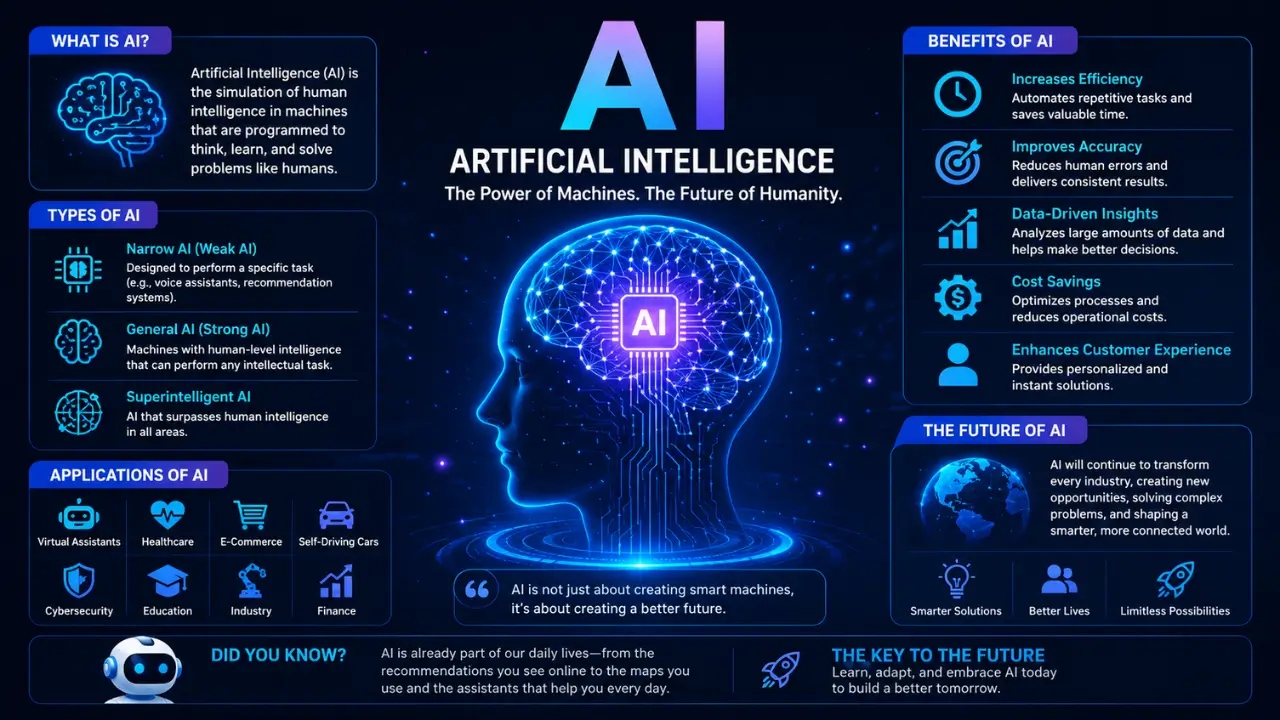
AI automation refers to the use of artificial intelligence technologies to perform tasks automatically with minimal human intervention. Unlike traditional automation, which follows fixed rules and instructions, AI can learn from data, recognize patterns, make predictions, and improve over time.
For example, traditional automation can automatically send an email when a customer fills out a form. AI automation can go further by analyzing the customer’s behavior, personalizing the email content, predicting future needs, and determining the best time to send the message.
In simple terms:
- Automation follows rules.
- AI learns and adapts.
- AI automation combines both for smarter workflows.
This combination allows businesses and individuals to save time, reduce errors, and increase efficiency.
Why AI Automation Matters Today
The amount of digital work being performed every day continues to grow rapidly. People manage emails, social media accounts, customer inquiries, documents, spreadsheets, marketing campaigns, and countless other tasks.
Many of these activities are repetitive and time-consuming.
AI automation helps eliminate unnecessary manual work so that people can focus on creativity, strategy, and higher-value activities.
Some reasons AI automation has become so important include:
Increased Productivity
AI automation can complete tasks in seconds that might take humans hours.
Cost Reduction
Businesses can reduce operational expenses by automating repetitive processes.
Improved Accuracy
Machines do not get tired or distracted, which helps reduce mistakes.
Better Customer Experience
AI-powered chatbots and support systems can provide instant assistance 24/7.
Faster Decision-Making
AI automation can analyze large amounts of data quickly and provide valuable insights.
As AI technology becomes more accessible, even small businesses and solo entrepreneurs can benefit from automation.
How AI Automation Works
Understanding the basics of AI automation is easier than many beginners think.
The process generally involves four key steps:
1. Data Collection
AI automation systems gather information from various sources such as:
- Websites
- Emails
- Databases
- Customer interactions
- Social media
- Documents
The more relevant data available, the better the AI can perform.
2. Data Analysis
The AI examines the collected information to identify patterns and trends.
For example, an AI marketing tool may analyze customer behavior to determine which products are most likely to sell.
3. Decision-Making
Based on the analysis, the AI determines the best action to take.
Examples include:
- Sending an email
- Answering a customer question
- Recommending a product
- Scheduling a meeting
4. Continuous Learning
Many AI automation systems improve over time through machine learning.
As they process more information, they become increasingly accurate and effective.
This learning capability is what separates AI automation from traditional automation systems.
The Difference Between Automation and AI Automation
Many beginners confuse automation with AI automation.
Let’s compare them.
Traditional Automation
Traditional automation follows predefined rules.
Example:
“If a customer submits a form, send a welcome email.”
The system performs exactly what it was programmed to do.
AI Automation
AI automation uses intelligence and learning.
Example:
“If a customer submits a form, analyze their interests, segment them into the correct audience, personalize the email, and predict future purchasing behavior.”
This creates a much more advanced and effective workflow.
The future belongs to AI automation because it provides flexibility, adaptability, and intelligent decision-making.
Common Examples of AI Automation
You probably use AI automation every day without realizing it.
Here are some common examples.
Email Filtering
Services like Gmail automatically identify spam messages and sort emails into categories.
Virtual Assistants
Digital assistants can answer questions, set reminders, and perform tasks using AI.
Recommendation Systems
Streaming platforms and online stores recommend content and products based on your behavior.
Chatbots
Many websites use AI chatbots to answer customer questions instantly.
Social Media Scheduling
AI tools can determine the best times to publish content and even generate post ideas.
Content Creation
AI automation writing tools can assist with creating articles, product descriptions, and marketing content.
These applications demonstrate how AI automation simplifies daily activities.
Benefits of AI Automation for Beginners
Whether you’re an entrepreneur, blogger, freelancer, or small business owner, AI automation offers significant advantages.
Saves Time
One of the biggest benefits is time savings.
Tasks that once required hours can now be completed automatically.
Examples include:
- Scheduling posts
- Responding to common emails
- Data entry
- Report generation
Reduces Human Error
Manual work often leads to mistakes.
AI automation helps ensure consistency and accuracy.
Improves Efficiency
Businesses can accomplish more without increasing staff or working longer hours.
Supports Growth
As your business grows, automation can handle increasing workloads without requiring significant additional resources.
Enhances Customer Service
AI-powered systems can provide immediate responses and support around the clock.
Helps You Stay Competitive
Businesses that embrace AI automation often outperform competitors that rely solely on manual processes.
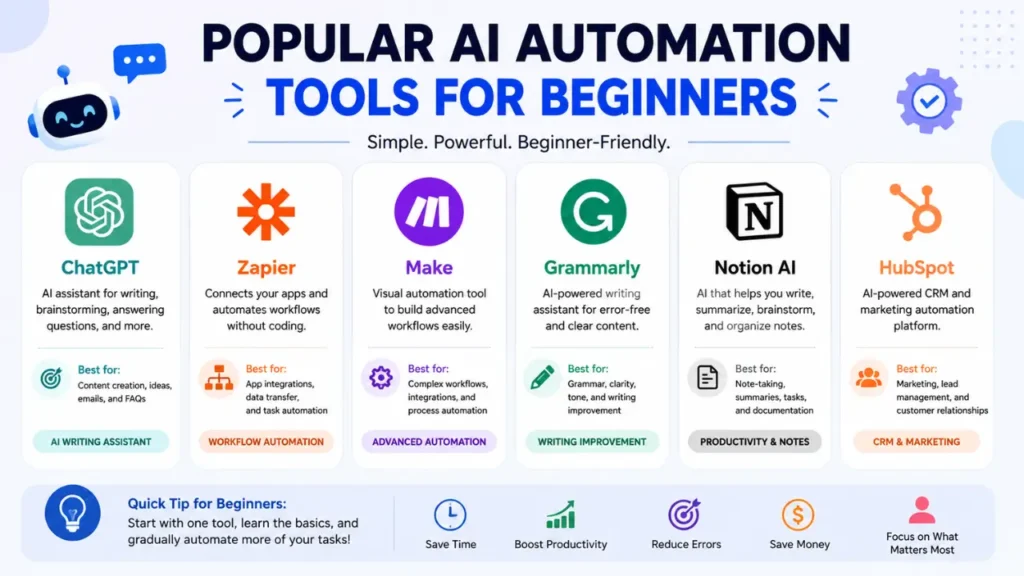
Popular AI Automation Tools for Beginners
The good news is that you do not need programming skills to start using AI automation.
Many beginner-friendly tools are available.
ChatGPT
ChatGPT helps generate content, answer questions, brainstorm ideas, and automate writing tasks.
Uses include:
- Blog posts
- Email drafts
- Social media content
- Customer support responses
Zapier
Zapier connects thousands of apps and automates workflows without coding.
Examples:
- Save email attachments automatically
- Create tasks from forms
- Sync customer data
Make
Make offers powerful visual automation workflows and advanced integrations.
It allows users to build sophisticated automation systems through drag-and-drop tools.
Grammarly
Grammarly uses AI to improve writing quality and grammar.
Notion AI
Notion AI helps summarize notes, generate content, and organize information efficiently.
HubSpot
HubSpot provides AI-powered marketing, customer relationship management, and sales automation tools.
These platforms make AI automation accessible even to complete beginners.
AI Automation for Small Businesses
Small businesses often operate with limited budgets and resources.
AI automation can provide significant advantages.
Customer Support
AI chatbots answer common questions instantly.
Marketing Automation
Businesses can automate:
- Email campaigns
- Social media posting
- Lead nurturing
- Customer segmentation
Appointment Scheduling
AI scheduling tools eliminate back-and-forth communication.
Inventory Management
AI can predict demand and help optimize stock levels.
Sales Automation
AI tools identify potential customers and prioritize leads.
These improvements allow small businesses to compete more effectively with larger organizations.
AI Automation for Content Creators
Bloggers, YouTubers, influencers, and website owners can greatly benefit from AI automation.
Content Research
AI tools can identify trending topics and keywords.
Content Writing
AI assists with drafting articles, outlines, and social media posts.
SEO Optimization
AI tools help improve search engine rankings.
Video Production
AI can generate subtitles, summaries, and video scripts.
Social Media Management
Automation tools schedule posts and analyze engagement metrics.
For content creators, AI automation can significantly increase output while reducing workload.
AI Automation and SEO
Search Engine Optimization (SEO) is one area where AI automation is making a huge impact.
AI tools can assist with:
Keyword Research
Finding valuable search terms quickly.
Content Optimization
Improving readability and keyword placement.
Competitor Analysis
Identifying opportunities based on competitor performance.
Technical SEO
Detecting website issues and recommending improvements.
Content Planning
Generating content calendars and topic clusters.
By automating these tasks, website owners can focus more on creating valuable content.
Common AI Automation Mistakes Beginners Should Avoid
Although AI automation is powerful, beginners often make mistakes.
Trying to Automate Everything
Not every process should be automated.
Focus on repetitive and time-consuming tasks first.
Ignoring Human Oversight
AI should assist humans, not completely replace them.
Always review important outputs.
Using Too Many Tools
Start with one or two platforms before expanding.
Poor Data Quality
AI systems depend on accurate data.
Poor information leads to poor results.
Lack of Clear Goals
Define what you want to achieve before implementing automation.
Avoiding these mistakes will help ensure successful implementation.
How to Start with AI Automation
Getting started is easier than many people think.
Step 1: Identify Repetitive Tasks
Look for activities you perform repeatedly.
Examples:
- Sending emails
- Scheduling content
- Data entry
- Customer support
Step 2: Choose One Tool
Start with a beginner-friendly platform such as ChatGPT or Zapier.
Step 3: Create a Simple Workflow
Begin with a basic automation process.
For example:
Form submission → Welcome email → CRM update.
Step 4: Test and Monitor
Evaluate results and make improvements.
Step 5: Expand Gradually
Once comfortable, automate additional processes.
Small steps often lead to the best long-term results.
The Future of AI Automation
The future of AI automation looks incredibly promising.
Several trends are expected to shape the next few years.
Smarter AI Agents
AI systems will perform increasingly complex tasks independently.
Hyper-Personalization
Businesses will deliver highly personalized experiences.
Voice-Based Automation
Voice assistants will become more capable and integrated into workflows.
Predictive Automation
AI will anticipate needs before users even request assistance.
Greater Accessibility
Automation tools will become easier and more affordable for everyone.
As these technologies evolve, AI automation will become a standard part of both personal and professional life.
Frequently Asked Questions About AI Automation
Is AI automation difficult to learn?
No. Many modern AI automation tools are designed specifically for beginners and require little or no coding knowledge.
Can AI automation replace jobs?
AI may automate certain repetitive tasks, but it also creates new opportunities and allows people to focus on higher-value work.
Is AI automation expensive?
Many tools offer free plans or affordable subscriptions, making AI automation accessible to individuals and small businesses.
What industries use AI automation?
Virtually every industry uses AI automation, including healthcare, finance, education, retail, manufacturing, marketing, and customer service.
Do I need programming skills?
No. Most beginner-friendly AI automation platforms use visual interfaces and drag-and-drop workflows.
Conclusion
AI automation is rapidly changing the way people work, communicate, and manage businesses. By combining artificial intelligence with automated workflows, individuals and organizations can save time, reduce errors, improve productivity, and achieve better results.
For beginners, the best approach is to start small. Identify repetitive tasks, choose a simple automation tool, and gradually build more advanced workflows as your confidence grows.
The businesses and professionals who embrace AI automation today will be better prepared for the future. Whether you run a website, create content, manage a small business, or simply want to become more productive, AI automation offers practical solutions that can transform the way you work.
The journey into AI automation begins with a single step—and there has never been a better time to start.