Introduction
Artificial Intelligence (AI) has become one of the most transformative technologies of the 21st century. From virtual assistants and self-driving cars to advanced medical diagnostics and content generation, AI is rapidly changing how people live and work. As these intelligent systems become more capable, an important question continues to emerge: AI vs Human Intelligence—which is superior? AI is a real threat to change the job market? AI can replace human routine tasks? Or is a powerful tool to boost human work? How people are think about the new era of technology?
The comparison between artificial intelligence and human intelligence has fascinated scientists, technologists, philosophers, and everyday people alike. While AI can process vast amounts of data in seconds and perform complex calculations with remarkable accuracy, humans possess creativity, emotional understanding, intuition, and moral reasoning that machines still struggle to replicate.
This article explores the differences, strengths, limitations, and future relationship between AI and human intelligence. By understanding what makes each unique, we can better appreciate how humans and machines may work together in the future.
What Is Artificial Intelligence?
Artificial Intelligence refers to computer systems designed to perform tasks that normally require human intelligence. These tasks include learning, reasoning, problem-solving, decision-making, language understanding, and pattern recognition.
AI systems use algorithms, machine learning models, neural networks, and large datasets to improve their performance over time.
Types of AI
Narrow AI
Narrow AI is designed for specific tasks. Examples include:
- Chatbots
- Recommendation systems
- Facial recognition software
- Voice assistants
- Fraud detection systems
Most AI systems today fall into this category.
General AI (AGI)
Artificial General Intelligence (AGI) refers to a hypothetical AI capable of understanding and performing any intellectual task that a human can do.
AGI remains a goal rather than a reality. Researchers continue to debate when—or if—it will be achieved.
Superintelligence
Artificial Superintelligence describes an AI that surpasses human intelligence in virtually every field, including creativity, scientific discovery, and social intelligence.
This concept remains theoretical but is widely discussed in AI research and ethics circles.
What Is Human Intelligence?
Human intelligence is the ability to learn, reason, understand, adapt, create, and solve problems based on experience and knowledge.
Unlike AI, human intelligence evolved over millions of years through biological processes. It combines logic, emotion, social understanding, creativity, and consciousness.
Humans can navigate uncertainty, interpret subtle contexts, and make decisions influenced by values, beliefs, and emotions.
Key Components of Human Intelligence
Emotional Intelligence
Humans can understand and manage emotions, both their own and those of others.
Creativity
People can generate entirely new ideas, artistic works, inventions, and solutions.
Adaptability
Humans can quickly adjust to unexpected situations with limited information.
Moral Reasoning
People consider ethics, fairness, empathy, and societal consequences when making decisions.
AI vs Human Intelligence: Key Differences
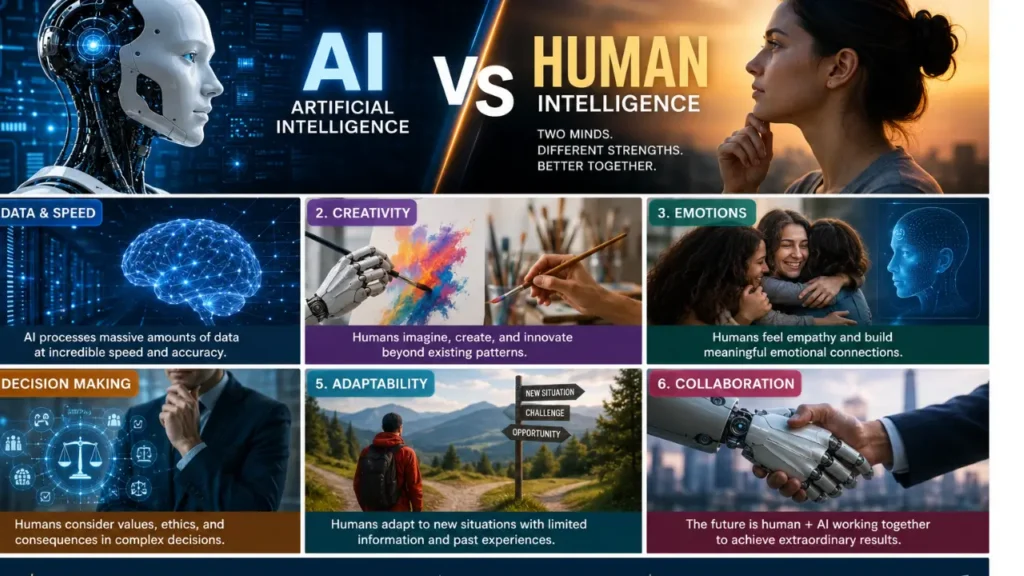
Although AI can imitate certain aspects of human thinking, there are significant differences between the two.
Learning Process
AI Learning
AI learns through:
- Data analysis
- Pattern recognition
- Statistical models
- Machine learning algorithms
The more quality data AI receives, the better it generally performs.
Human Learning
Humans learn through:
- Experience
- Observation
- Education
- Emotions
- Social interactions
A person can often learn from a single experience, while AI may require millions of examples.
Speed and Processing Power
One area where AI clearly outperforms humans is processing speed.
AI can:
- Analyze billions of data points
- Search massive databases instantly
- Perform calculations at incredible speed
- Operate continuously without fatigue
Humans, by comparison, process information much more slowly.
Winner: AI
Creativity and Innovation
AI can generate text, images, music, and designs based on existing patterns.
However, human creativity remains fundamentally different.
Humans can:
- Imagine entirely new concepts
- Create original art
- Develop revolutionary inventions
- Think beyond existing data
Many experts argue that AI recombines information rather than truly creating something original.
Winner: Human Intelligence
Emotional Understanding
AI can recognize emotional cues from text, voice, or facial expressions.
However, it does not actually experience emotions.
Humans possess:
- Empathy
- Compassion
- Love
- Fear
- Joy
- Emotional awareness
These emotional experiences influence decision-making and relationships.
Winner: Human Intelligence
Memory Capacity
AI systems can store enormous amounts of information with near-perfect recall.
Humans often forget details over time.
AI can instantly retrieve:
- Documents
- Images
- Data records
- Historical information
Winner: AI
Decision-Making
AI decisions are typically based on data and probabilities.
Human decisions often include:
- Ethics
- Values
- Intuition
- Social context
- Emotional considerations
While AI may be more objective in some situations, humans can better navigate complex moral dilemmas.
Winner: Human Intelligence
The Strengths of Artificial Intelligence
AI offers numerous advantages that make it valuable across industries.
1. Exceptional Data Analysis
Modern organizations generate enormous amounts of data every day.
AI can:
- Identify trends
- Detect anomalies
- Predict outcomes
- Generate insights
This capability helps businesses make better decisions.
2. Continuous Operation
Unlike humans, AI systems do not require:
- Sleep
- Breaks
- Vacations
They can operate 24 hours a day, seven days a week.
3. Consistency
AI performs tasks with a high level of consistency.
Humans may make mistakes due to:
- Fatigue
- Stress
- Distractions
AI generally maintains stable performance.
4. Scalability
Once developed, AI systems can be deployed to millions of users simultaneously.
This scalability makes AI highly cost-effective.
5. Pattern Recognition
AI excels at identifying patterns in large datasets.
Applications include:
- Medical imaging
- Fraud detection
- Weather forecasting
- Cybersecurity
The Strengths of Human Intelligence
Despite AI’s impressive capabilities, human intelligence remains extraordinary.
1. Creativity
Human innovation has produced:
- Art
- Literature
- Music
- Scientific breakthroughs
- Technological revolutions
Creativity remains one of humanity’s greatest strengths.
2. Emotional Intelligence
Successful relationships depend on emotional understanding.
Humans excel at:
- Reading social cues
- Building trust
- Resolving conflicts
- Supporting others emotionally
These abilities are difficult for AI to replicate.
3. Critical Thinking
Humans can evaluate information critically and challenge assumptions.
Critical thinking allows people to:
- Question evidence
- Consider alternatives
- Explore uncertainty
AI typically operates within the boundaries of its training data.
4. Adaptability
Humans can handle situations they have never encountered before.
For example, a person can improvise solutions during emergencies without prior training data.
5. Ethical Judgment
Humans consider:
- Right and wrong
- Social impact
- Cultural values
- Long-term consequences
Ethical reasoning remains one of the most significant distinctions between human intelligence and AI.
Can AI Replace Human Intelligence?
This question generates intense debate.
The answer depends on the type of work being considered.
Jobs AI Can Automate
AI is particularly effective at repetitive tasks such as:
- Data entry
- Scheduling
- Customer support
- Inventory management
- Basic content generation
These tasks follow predictable patterns that AI can learn efficiently.
Jobs That Still Need Humans
Many professions require uniquely human capabilities.
Examples include:
- Psychologists
- Teachers
- Social workers
- Leaders
- Artists
- Entrepreneurs
These roles depend heavily on creativity, empathy, and complex judgment.
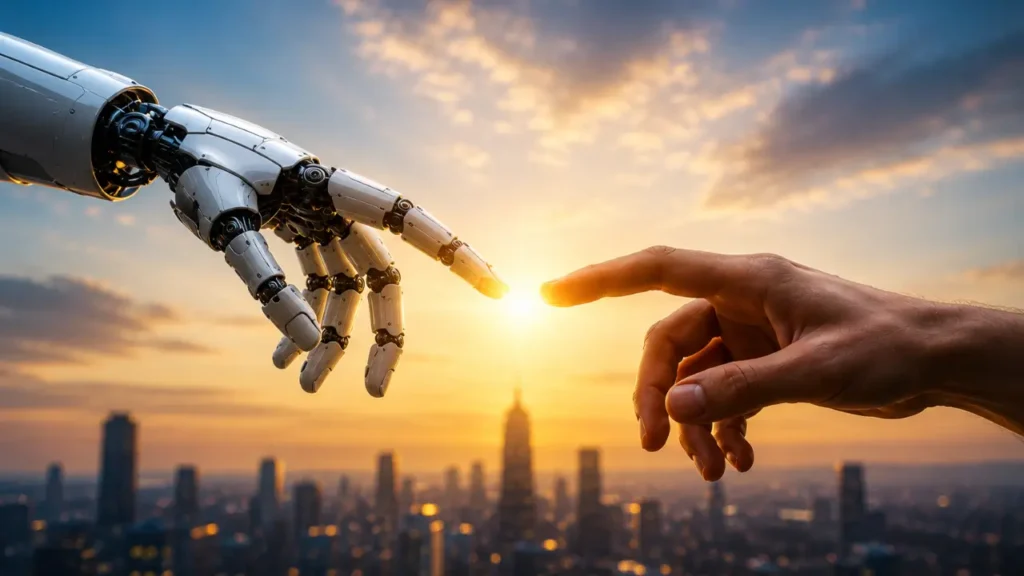
The Future Is Collaboration
Rather than replacing humans entirely, AI is more likely to enhance human capabilities.
This concept is often called Human-AI Collaboration.
Examples include:
- Doctors using AI to improve diagnoses
- Engineers using AI for design optimization
- Writers using AI for research assistance
- Scientists using AI to accelerate discoveries
The combination of human intelligence and AI often produces better results than either working alone.
AI vs Human Intelligence in Healthcare
Healthcare demonstrates the power of combining both forms of intelligence.
AI Contributions
AI can:
- Analyze medical images
- Detect diseases
- Predict patient risks
- Process health records
AI often identifies patterns invisible to humans.
Human Contributions
Doctors provide:
- Empathy
- Patient communication
- Ethical decision-making
- Personalized treatment planning
Patients frequently value human understanding as much as medical expertise.
The Best Outcome
The strongest healthcare systems combine AI efficiency with human compassion.
AI vs Human Intelligence in Creativity
One of the most controversial areas is creativity.
AI-generated art, music, and writing have improved dramatically.
However, human creativity remains unique.
Why Human Creativity Matters
Creative works often emerge from:
- Life experiences
- Emotions
- Culture
- Personal struggles
- Dreams and aspirations
These deeply human experiences influence artistic expression.
AI as a Creative Tool
Rather than replacing artists, AI can serve as a creative assistant.
Examples include:
- Generating concepts
- Suggesting designs
- Editing content
- Creating prototypes
Many creators now use AI to enhance productivity while maintaining human artistic direction.
The Limitations of Artificial Intelligence
Despite impressive progress, AI has important limitations.
Lack of Consciousness
AI does not possess self-awareness.
It processes information but does not truly understand experiences in the way humans do.
Dependence on Data
AI systems rely heavily on training data.
Poor-quality data can lead to:
- Errors
- Biases
- Incorrect predictions
Limited Common Sense
Humans use common sense daily.
AI often struggles with situations that seem obvious to people.
Ethical Challenges
AI raises concerns regarding:
- Privacy
- Bias
- Surveillance
- Employment disruption
- Accountability
Society must address these challenges responsibly.
The Future of AI and Human Intelligence
The future is unlikely to be a simple competition between humans and machines.
Instead, it may become a partnership.
Emerging Trends
AI Assistants
Advanced assistants will help individuals work more efficiently.
Personalized Education
AI could create customized learning experiences for students.
Scientific Discovery
Researchers may use AI to accelerate breakthroughs in medicine, energy, and climate science.
Human Enhancement
Brain-computer interfaces and advanced technologies may blur the line between human and artificial intelligence.
Will AGI Change Everything?
If Artificial General Intelligence becomes reality, the relationship between humans and machines could change dramatically.
Potential outcomes include:
- Massive productivity gains
- New scientific discoveries
- Economic transformation
- Ethical and regulatory challenges
Experts continue to debate how society should prepare for this possibility.
Frequently Asked Questions About AI vs Human Intelligence
Is AI smarter than humans?
AI is smarter than humans in specific tasks involving speed, memory, and data analysis. However, humans remain superior in creativity, emotional intelligence, and ethical reasoning.
Can AI become conscious?
Currently, there is no evidence that AI possesses consciousness or self-awareness. Whether machines can become conscious remains an open question.
Will AI replace all jobs?
No. While AI will automate many tasks, numerous professions require uniquely human skills that are difficult to replace.
What is the biggest advantage of human intelligence?
The ability to combine creativity, emotional understanding, adaptability, and ethical judgment.
What is the biggest advantage of AI?
Its capacity to process enormous amounts of information quickly and accurately.
Conclusion
The debate surrounding AI vs Human Intelligence is not simply about determining a winner. Artificial intelligence and human intelligence possess fundamentally different strengths.
AI excels at speed, data processing, consistency, and pattern recognition. Human intelligence shines through creativity, empathy, adaptability, moral reasoning, and innovation. While AI continues to evolve rapidly, it still lacks many of the qualities that define human experience.
The most likely future is not one where machines replace people, but one where humans and AI work together to achieve extraordinary results. Organizations, educators, healthcare professionals, and individuals who learn to leverage both forms of intelligence will be best positioned to thrive in the coming decades.
As technology advances, the real question may no longer be “AI vs Human Intelligence,” but rather: How can AI and human intelligence combine to create a better future for everyone?
Interested in discovering how artificial intelligence is transforming the world? Check out our latest articles on AGI Explained for Beginners https://growthpoweredai.com/2026/06/15/agi-explained-for-beginners/