Artificial Intelligence (AI) has become one of the most talked-about technologies in the world. From chatbots and virtual assistants to self-driving cars and advanced medical systems, AI is transforming how we live and work. But beyond today’s Artificial Intelligence systems lies a concept that many experts believe could become the most important technological breakthrough in human history: Artificial General Intelligence.
If you’ve heard the term AGI and wondered what it means, you’re not alone. Many people confuse AGI with the AI tools they use every day. While today’s AI can perform specific tasks extremely well, AGI represents something far more powerful and potentially revolutionary.
In this beginner-friendly guide, we’ll explore what AGI is, how it differs from current AI technologies, why researchers are pursuing it, the challenges involved, and how AGI could reshape society in the future.
What Is AGI?
Artificial General Intelligence (AGI) refers to a type of artificial intelligence that can understand, learn, and apply knowledge across a wide range of tasks at a level comparable to or exceeding human intelligence.
Unlike today’s AI systems, which are designed for specific purposes, AGI would be capable of performing virtually any intellectual task that a human can do.
Imagine a system that can:
- Learn a new language
- Write a novel
- Solve complex scientific problems
- Manage a business
- Design new technologies
- Teach students
- Conduct medical research
And do all of these tasks without needing separate programming for each one.
That is the vision of AGI.
Understanding the Difference Between AI and AGI
To understand AGI, it’s important to first understand the type of AI we use today.
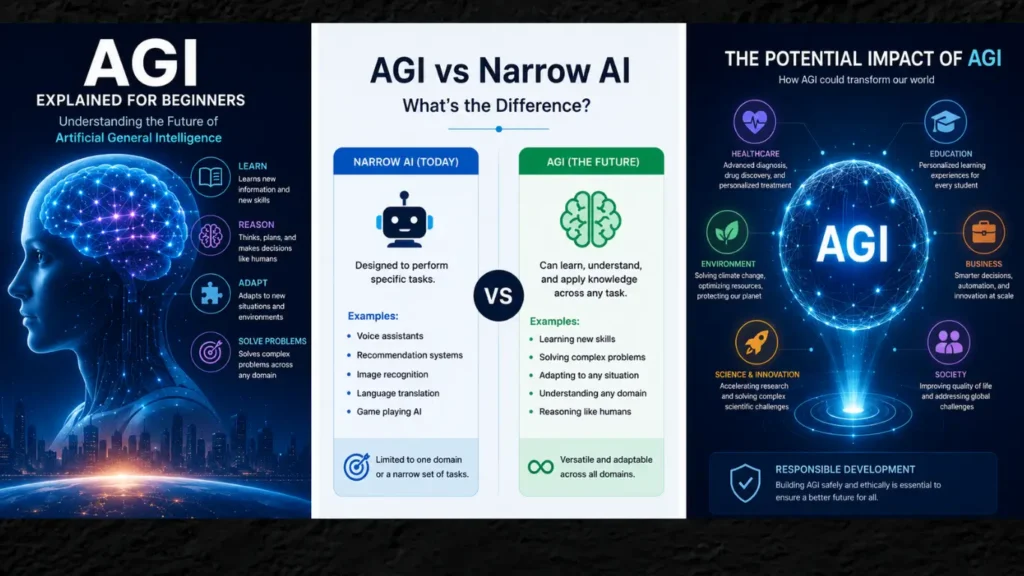
Narrow AI (Today’s AI)
Most AI systems currently available are examples of Narrow AI, also known as Weak AI.
These systems are designed to perform a specific task or a limited set of tasks.
Examples include:
- ChatGPT generating text
- Siri answering voice commands
- Netflix recommending movies
- Google Translate translating languages
- Facial recognition software
- Chess-playing AI systems
While these tools can be incredibly powerful, they are limited to their designated functions.
A chess AI may beat the world’s best player but cannot drive a car.
A language model may write essays but cannot independently run a scientific laboratory.
This limitation is what separates current AI from AGI.
Artificial General Intelligence
AGI would not be limited to one domain.
Instead, it could:
- Transfer knowledge between tasks
- Adapt to unfamiliar situations
- Learn new skills independently
- Reason like humans
- Make decisions across multiple disciplines
This flexibility is what makes AGI fundamentally different from today’s AI systems.
Why Is AGI Considered So Important?
Many experts believe AGI could become one of the most transformative inventions in human history.
Some compare its potential impact to:
- The Industrial Revolution
- The invention of electricity
- The internet
- Modern computing
The reason is simple: intelligence is the foundation of problem-solving.
If machines develop human-level reasoning abilities, they could help solve challenges that currently exceed human capabilities.
Accelerating Scientific Discovery
AGI could dramatically speed up research in fields such as:
- Medicine
- Physics
- Climate science
- Renewable energy
- Biotechnology
Instead of taking years to analyze data and develop solutions, AGI systems could potentially perform these tasks in days or even hours.
Improving Healthcare
Healthcare could experience major breakthroughs through AGI.
Potential applications include:
- Early disease detection
- Personalized treatments
- Drug discovery
- Medical imaging analysis
- Surgical assistance
AGI might help doctors make more accurate diagnoses while improving patient outcomes worldwide.
Solving Complex Global Problems
Many global challenges involve enormous amounts of data and complicated variables.
AGI could assist with:
- Climate change solutions
- Food production optimization
- Water resource management
- Disaster prediction
- Economic planning
Its ability to process information at scale could lead to innovative solutions beyond current human capabilities.
How Does AGI Learn?
One of the defining characteristics of AGI is its ability to learn continuously.
Humans learn through:
- Observation
- Experience
- Reasoning
- Trial and error
AGI aims to replicate these capabilities.
Learning Beyond Training Data
Current AI systems primarily learn from large datasets.
AGI would go much further by:
- Understanding concepts
- Applying knowledge in new situations
- Learning with minimal examples
- Adapting to changing environments
For example, if an AGI learned how to play one strategy game, it could potentially apply similar reasoning to other games without extensive retraining.
This type of flexibility is closer to how humans learn.
The Incredible Capabilities AGI Could Have
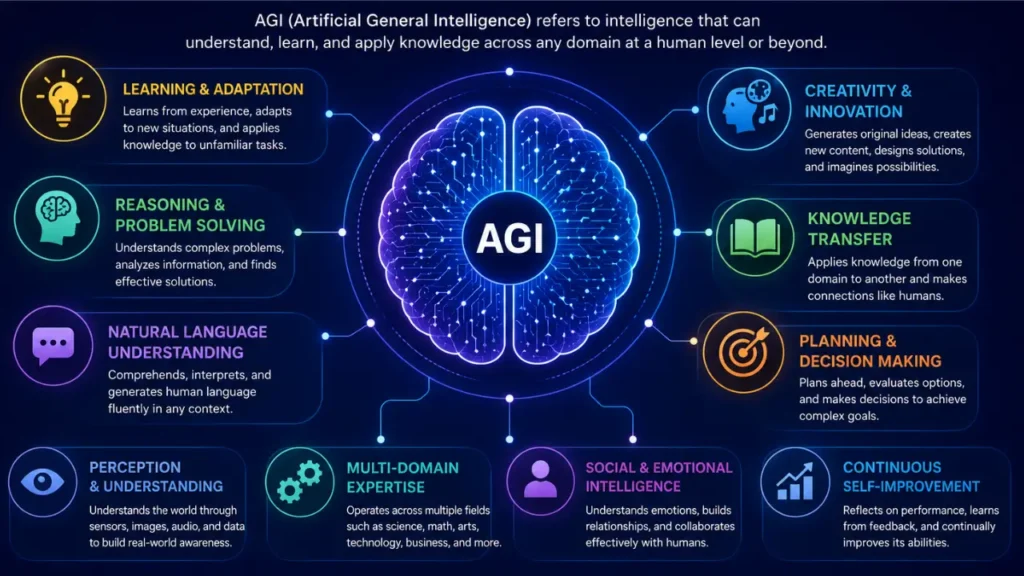
Although AGI does not yet exist, researchers often discuss the capabilities it might possess.
Advanced Reasoning
AGI could analyze problems from multiple perspectives and generate highly effective solutions.
Creativity
Creativity is often viewed as a uniquely human trait.
However, AGI may eventually be capable of:
- Writing books
- Composing music
- Creating artwork
- Inventing new technologies
Some experts believe AGI could even exceed human creativity in certain domains.
Continuous Self-Improvement
One of the most fascinating possibilities is that AGI could improve itself.
If an AGI can redesign its own software and architecture, it may become increasingly intelligent over time.
This concept is often referred to as recursive self-improvement.
What Is the Difference Between AGI and Superintelligence?
Many people use AGI and superintelligence interchangeably, but they are not the same thing.
AGI
AGI represents intelligence roughly equivalent to human cognitive abilities across a broad range of tasks.
Artificial Superintelligence (ASI)
Artificial Superintelligence refers to intelligence that greatly surpasses human capabilities in virtually every field.
This would include:
- Science
- Creativity
- Engineering
- Business
- Strategic thinking
Many researchers believe AGI could eventually lead to ASI if self-improvement becomes possible.
Are We Close to Achieving AGI?
This is one of the most debated questions in technology today.
No one knows exactly when AGI will arrive.
Expert predictions vary significantly.
Some researchers believe AGI could emerge within the next decade.
Others think it may take several decades or even longer.
Why Predictions Differ
The challenge is that intelligence itself remains poorly understood.
Scientists still don’t fully understand:
- Human consciousness
- Human reasoning
- Learning mechanisms
- Creativity
- Emotional intelligence
Without fully understanding human intelligence, creating AGI remains an enormous challenge.
Major Challenges in Building AGI
Developing AGI is far more difficult than creating today’s AI systems.
Researchers face several obstacles.
Understanding Human Intelligence
Human cognition involves countless interconnected processes.
Replicating these processes in machines is extraordinarily complex.
Common Sense Reasoning
Humans possess common sense knowledge that seems effortless.
For example:
- Ice is cold
- Water makes things wet
- Objects fall when dropped
Teaching machines this intuitive understanding remains a significant challenge.
Long-Term Memory
AGI would need robust memory systems capable of storing and using information over long periods.
Adaptability
Humans adapt quickly to new situations.
Creating machines with similar flexibility remains a difficult problem.
The Potential Risks of AGI
While AGI could bring enormous benefits, experts also discuss potential risks.
Job Displacement
AGI could automate many tasks currently performed by humans.
This may affect industries such as:
- Customer service
- Transportation
- Finance
- Healthcare
- Manufacturing
Governments and businesses may need new strategies to address workforce transitions.
Safety Concerns
An AGI system must be aligned with human values.
If goals are poorly defined, unintended consequences could occur.
Researchers are actively working on AI safety to reduce these risks.
Ethical Questions
AGI raises important ethical issues, including:
- Privacy
- Decision-making authority
- Accountability
- Fairness
- Human oversight
These topics are becoming increasingly important as AI technology advances.
How AGI Could Change Everyday Life
If AGI becomes reality, daily life may look dramatically different.
Personalized Education
Every student could have access to an intelligent tutor that adapts lessons to their learning style.
Advanced Healthcare Assistants
AGI-powered assistants could help monitor health conditions and provide personalized medical recommendations.
Smarter Work Environments
Businesses may use AGI to:
- Improve productivity
- Optimize operations
- Analyze data
- Support decision-making
Enhanced Creativity
Artists, writers, and creators could collaborate with AGI systems to produce entirely new forms of content.
Companies Leading the AGI Race
Several organizations are actively researching AGI technologies.
Some of the most prominent include:
- OpenAI
- Google DeepMind
- Anthropic
- Meta
- Microsoft
- xAI
These companies invest billions of dollars into AI research and development, aiming to create increasingly capable systems.
What Experts Say About AGI
The scientific community remains divided on AGI timelines and outcomes.
Some experts view AGI as an inevitable technological milestone.
Others believe significant breakthroughs are still required before AGI becomes possible.
Despite differing opinions, most researchers agree that AGI would represent a historic turning point for humanity.
Preparing for an AGI Future
Whether AGI arrives in ten years or fifty years, its potential impact makes preparation important.
Individuals can prepare by:
- Learning about AI technologies
- Developing adaptable skills
- Improving digital literacy
- Understanding automation trends
- Staying informed about technological developments
The future workforce will likely value creativity, critical thinking, emotional intelligence, and complex problem-solving more than ever.
Conclusion
Artificial General Intelligence represents one of the most ambitious goals in the history of technology. Unlike today’s narrow AI systems, AGI aims to create machines capable of learning, reasoning, adapting, and solving problems across virtually any domain, much like humans do.
While AGI has not yet been achieved, progress in artificial intelligence continues to accelerate. Researchers around the world are working to overcome major challenges related to reasoning, memory, adaptability, and safety.
The potential benefits are extraordinary, from medical breakthroughs and scientific discoveries to personalized education and solutions for global challenges. At the same time, AGI raises important questions about ethics, employment, safety, and the future relationship between humans and intelligent machines.
For beginners, understanding AGI is more than simply learning about a new technology. It is about exploring a future that could fundamentally transform civilization. Whether AGI arrives sooner or later, one thing is clear: the conversation surrounding Artificial General Intelligence is only beginning, and its impact may shape the world for generations to come.
Frequently Asked Questions (FAQ)
What does AGI stand for?
AGI stands for Artificial General Intelligence, a form of AI capable of performing any intellectual task that a human can do.
Does AGI exist today?
No. Current AI systems are considered Narrow AI and are designed for specific tasks. True AGI has not yet been achieved.
How is AGI different from AI?
Most AI today specializes in specific functions. AGI would be capable of learning and adapting across many different tasks without requiring separate programming.
Will AGI replace human jobs?
AGI could automate many tasks, but it may also create new industries, opportunities, and forms of employment.
When will AGI be developed?
No one knows for certain. Predictions range from the next decade to many decades in the future.
Could AGI become smarter than humans?
Potentially. Some researchers believe AGI could eventually evolve into Artificial Superintelligence, surpassing human intelligence in many areas.
Interested in discovering how artificial intelligence is transforming the world? Check out our latest articles on /https://growthpoweredai.com/2026/06/02/incredible-rise-of-humanoid-robots/