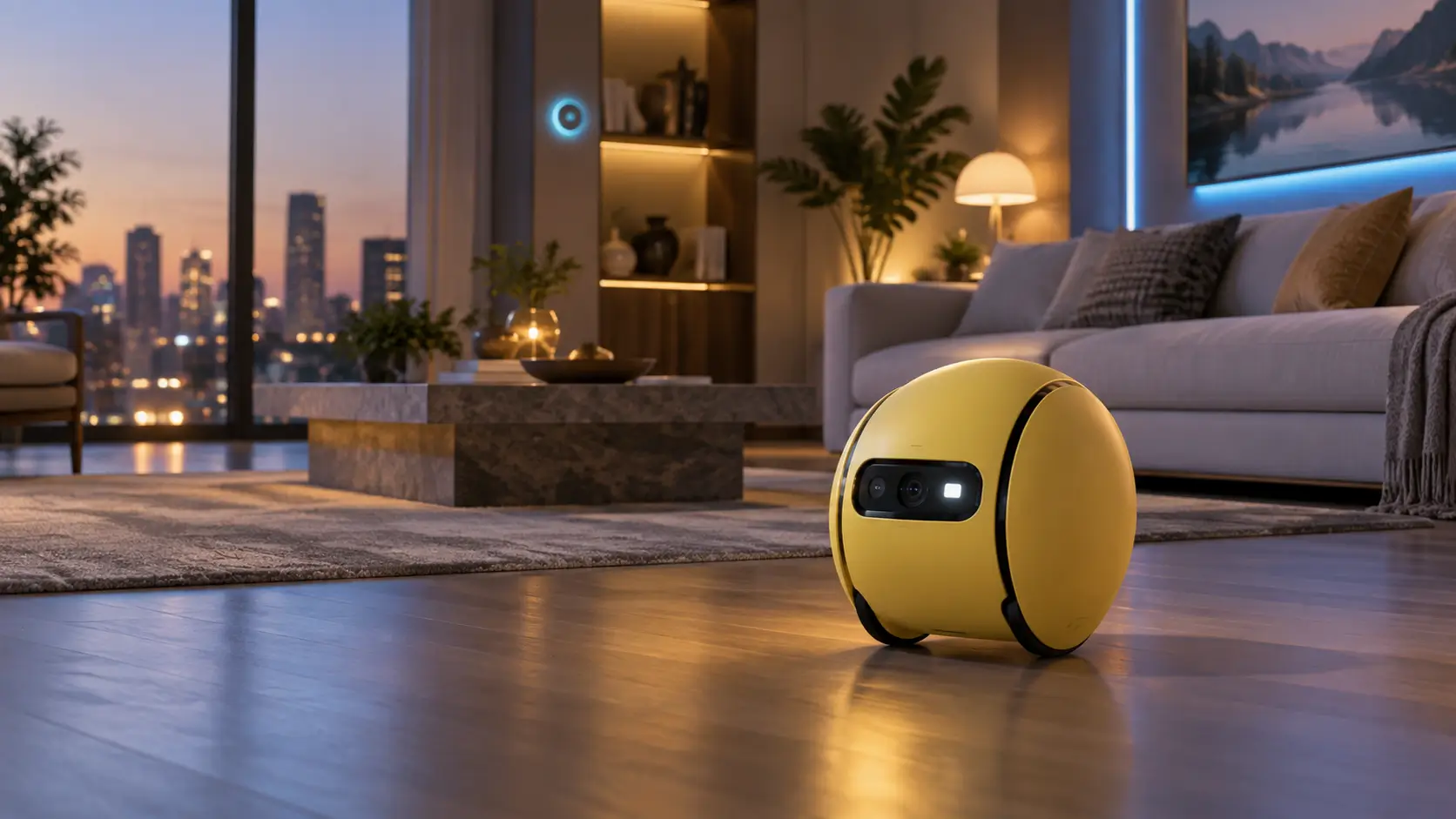
The Samsung Ballie robot is one of the most memorable visions of the future home ever presented by a major technology company. Instead of looking like a humanoid machine from a science-fiction movie, Ballie is small, friendly, and designed to roll naturally from room to room. Its purpose is not to replace people or perform heavy physical labor. Samsung imagines it as a mobile AI companion that can understand its surroundings, communicate with household members, control connected devices, and display useful information wherever it is needed.
Ballie first attracted attention when Samsung introduced an earlier concept at CES 2020. The company later revealed a substantially redesigned version at CES 2024, giving the robot a built-in projector and presenting it as a more capable smart-home assistant. In April 2025, Samsung and Google Cloud announced that Ballie would use Google’s Gemini generative AI alongside Samsung’s own language models. The companies said the combination would support natural conversations, multimodal understanding, and personalized assistance.
However, there is an important fact potential buyers need to know. Samsung originally announced that Ballie would become available in the United States and South Korea in the summer of 2025, but that release window passed without a consumer launch. By 2026, reports indicated that Samsung was referring to Ballie as an “active innovation platform” rather than confirming a new sales date. As a result, Ballie should currently be understood as an advanced Samsung robotics project—not a widely available product that consumers can order today.
Even without a confirmed retail launch, Ballie remains significant. It demonstrates how artificial intelligence, robotics, projection technology, cameras, sensors, and connected-home platforms could merge into a new kind of device. It may also influence future Samsung products even if this exact version never reaches stores.
What Is the Samsung Ballie Robot?
The Samsung Ballie robot is a compact, autonomous home companion developed by Samsung Electronics. Its rounded body and rolling movement give it a less intimidating appearance than a traditional robot. The design allows it to move through a home, follow users, observe the environment through cameras and sensors, and provide assistance in the location where it is most useful.
Most voice assistants remain fixed on a counter, desk, or wall. Ballie’s mobility changes that relationship. A stationary smart speaker waits for a person to approach it or speak loudly enough to be heard. A mobile robot can potentially travel toward the user, reposition itself for a better view, and bring its interface into different rooms.
Samsung has demonstrated Ballie performing tasks such as displaying schedules, presenting weather information, supporting exercise sessions, communicating with connected appliances, and projecting entertainment. The company has also shown how it could greet someone arriving home and provide timely information based on that person’s situation.
Ballie is therefore best described as a combination of several technologies:
- An AI voice and visual assistant
- A mobile smart-home controller
- A compact projector
- A connected camera and sensor platform
- A personal scheduling and information tool
- A potential remote home-monitoring device
This combination is what makes Ballie more interesting than a smart speaker on wheels. Its value depends on its ability to understand people, interpret the home around it, and choose how and where to respond.
How the Samsung Ballie Robot Has Evolved
The Original Ballie Concept at CES 2020
Samsung introduced the first Ballie concept at CES 2020. That version looked more like a small ball and was presented as a personal companion capable of following its owner, responding to needs, and interacting with smart-home devices. The demonstration communicated an ambitious idea: household AI should not be trapped inside a phone or speaker. It could move through the physical world and provide help in context.
The 2020 concept generated excitement, but Samsung did not release it as a consumer product. At that stage, Ballie was mainly a demonstration of Samsung’s ideas about robotics, artificial intelligence, and connected living.
The Redesigned Ballie at CES 2024
Ballie returned at CES 2024 with a completely updated appearance and a clearer purpose. The revised robot had a larger oval-shaped body, front and rear wheels, cameras, sensors, and a built-in projection system. Samsung’s demonstrations presented it as a companion that could travel around the home and project content onto walls, floors, or other suitable surfaces.
The projector gave Ballie a practical way to communicate visually without carrying a conventional screen. It could theoretically display a calendar near a desk, project a workout video in an open area, or show entertainment on a bedroom wall. That flexibility helped distinguish it from both smart displays and robot vacuums.
Gemini Integration Announced in 2025
In April 2025, Samsung and Google Cloud announced that Google’s Gemini technology would come to Ballie. According to the announcement, Ballie would combine Gemini’s multimodal capabilities with Samsung’s proprietary AI models.
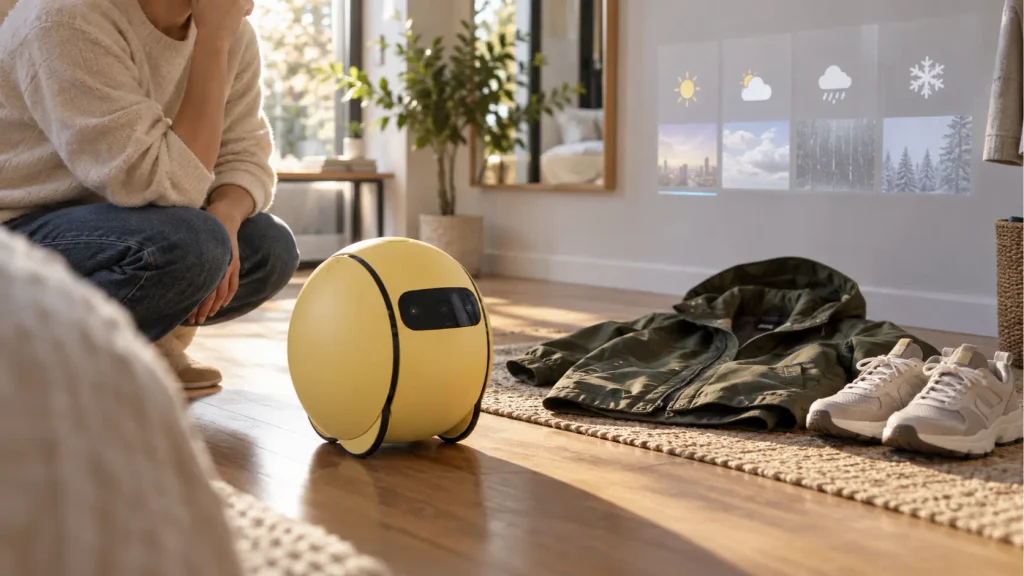
Multimodal AI can process more than one type of information. Instead of relying only on spoken words, it can work with combinations of voice, images, sensor data, and environmental context. Samsung offered examples in which Ballie could help a user choose an outfit or discuss wellness concerns after observing that the person appeared tired.
The announcement also stated that Ballie was expected to reach consumers in the United States and South Korea during the summer of 2025. That timetable was not fulfilled, and Samsung did not provide a replacement consumer launch date.
How Samsung Ballie Could Transform the Smart Home
Natural AI Conversations Throughout the Home
The most important feature of the Samsung Ballie robot may be its ability to support more natural conversations. Traditional voice assistants often depend on short, precisely structured commands. Generative AI can interpret follow-up questions, recognize conversational context, and produce more flexible responses.
For example, instead of giving separate instructions to check the weather, review a calendar, and adjust connected lights, a user might ask Ballie to help prepare for the day. An advanced assistant could combine relevant information and complete several appropriate actions.
Because Ballie can move, the conversation could continue as the user walks from a bedroom to a kitchen or home office. This creates the possibility of an assistant that feels present rather than attached to a single device.
Nevertheless, natural conversation is not the same as perfect understanding. Accents, background noise, ambiguous requests, and unreliable network connections could still affect performance. A successful consumer product would need dependable microphones, safe action limits, and clear ways to correct mistakes.
A Mobile SmartThings Controller
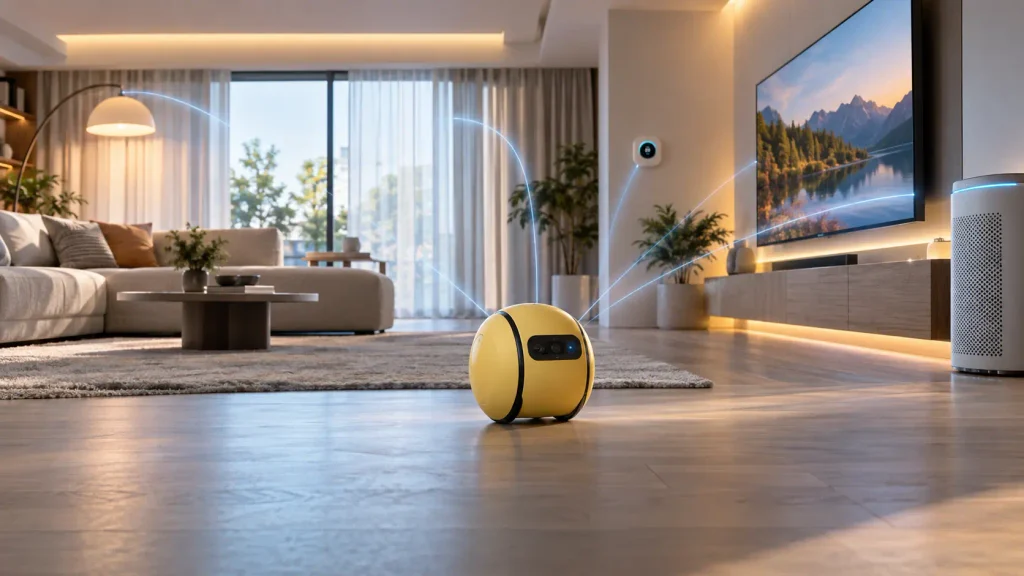
Samsung has built a broad connected-home ecosystem around SmartThings. Compatible products can include lights, televisions, appliances, thermostats, cameras, locks, sensors, and other devices. Ballie could become a mobile interface for this ecosystem.
Instead of opening several apps, a homeowner could potentially ask Ballie to dim the lights, turn on a television, adjust an air conditioner, or check whether a connected appliance has completed its cycle. Because the robot can move and perceive its surroundings, it may also provide more context than a standard phone application.
This idea becomes especially useful when automation involves multiple devices. Ballie might help start an evening routine that changes lighting, adjusts the temperature, and turns on entertainment. It could also communicate reminders associated with appliances or household schedules.
The practical value would depend on compatibility. Consumers would need clear information about which Samsung and third-party devices work with Ballie, which actions require confirmation, and what happens when an internet connection is unavailable.
Projection on Walls, Floors, and Other Surfaces
Ballie’s built-in projector is one of its most distinctive features. A fixed smart display can show information only from one location, while a mobile projector can bring content to different areas of a home.
Samsung has demonstrated projection for entertainment, video calls, schedules, and fitness content. Ballie could theoretically select a suitable surface and adjust the image according to the available space. A wall might become a screen for a movie, while a floor could display exercise instructions or interactive information.
This approach could reduce the need for screens in every room. It also gives the robot a visible interface that is larger than its body. However, real-world projection quality depends heavily on room brightness, surface color, viewing angle, resolution, and image size. Consumers would need verified specifications before comparing Ballie with a dedicated television or projector.
Personalized Scheduling and Reminders
A mobile AI companion could make reminders more useful by delivering them at the right place and time. Ballie may be able to connect schedules, routines, and household information to provide personalized notifications.
For example, it could remind a user about an appointment while projecting the day’s calendar. It might notify someone that a connected appliance has finished, suggest leaving early because of weather, or display a shopping reminder in the kitchen.
Generative AI could make these interactions more conversational. A user might ask Ballie to rearrange a morning plan, summarize upcoming commitments, or create reminders through natural language. In a multi-person home, however, the system would need reliable user recognition and strong privacy controls to prevent one person’s information from being shown to another.

Fitness and Wellness Assistance
Samsung has presented Ballie as a potential fitness and wellness assistant. Its projector could display exercise videos on a wall or floor, while the robot’s cameras might help it position the image or observe the user’s activity.
Integration with Samsung devices such as Galaxy phones and wearables could make this capability more powerful. With permission, Ballie might present workout information collected by a smartwatch, offer routine reminders, or help users view progress without holding a device.
Samsung and Google also described an example in which Ballie could respond to a person who appeared tired and provide suggestions. This demonstrates the promise of multimodal AI, but it also highlights an important limitation: a home robot should not be treated as a doctor. Wellness observations can be incomplete or incorrect, and any serious symptom requires guidance from a qualified healthcare professional.
Remote Home Monitoring and Updates
A robot that can travel between rooms may offer a different form of home monitoring. Rather than depending exclusively on fixed cameras, users might be able to ask Ballie to check a particular area, inspect the status of a pet, or provide an update about the home.
Samsung’s original Ballie demonstrations emphasized its ability to observe the environment and communicate with users. A mobile platform could potentially identify certain unusual conditions and send a notification or image. This may be valuable to people who want to check their homes while traveling or working elsewhere.
However, monitoring introduces major privacy and security questions. Cameras and microphones inside a mobile connected robot could collect highly sensitive information. Samsung would need transparent rules covering data storage, cloud processing, account protection, camera indicators, recording controls, and access permissions. Users should also be able to disable monitoring features easily.
More Context-Aware Assistance Through Multimodal AI
Gemini’s multimodal abilities could allow Ballie to interpret spoken requests together with what its cameras and sensors detect. This is different from a device that only hears a command.
Imagine asking, “Does this outfit work for today?” A context-aware assistant could consider the visible clothing, local weather, and the user’s schedule before responding. In another example, a user could point toward an object and ask a question without needing to describe it precisely.
Context makes AI more convenient, but it also raises the risk of inaccurate assumptions. Ballie might misunderstand what it sees or infer something the user did not intend. The system would need to indicate uncertainty rather than presenting every conclusion as a fact. People should remain in control of consequential decisions.
Support for Families, Older Adults, and Busy Households
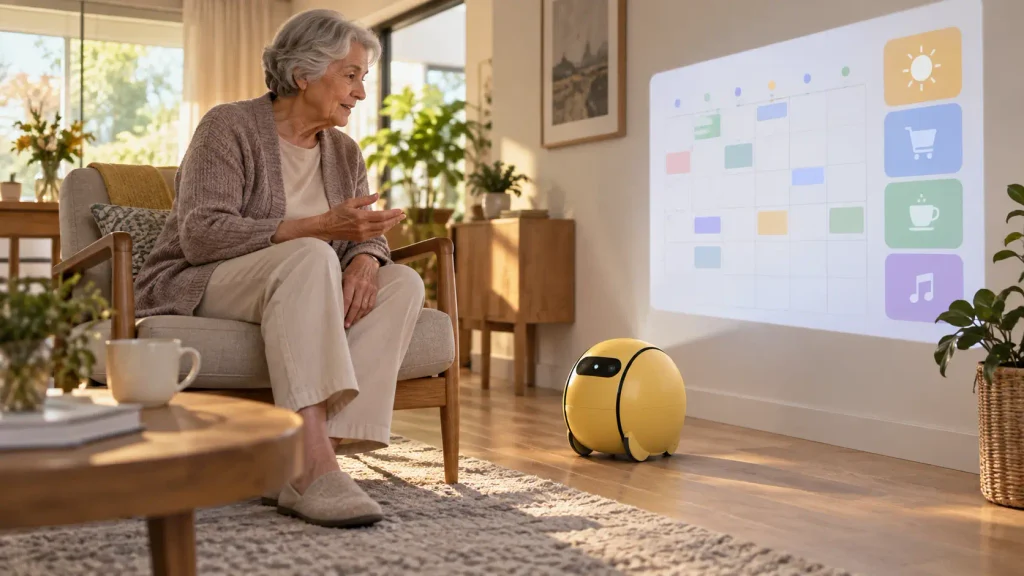
A well-designed home robot could reduce small points of friction for many users. Parents might use it for schedules and household reminders. Older adults could benefit from spoken assistance and projected information that is easier to see than a phone screen. Busy professionals might appreciate a mobile calendar, smart-home controller, and video-call device.
Accessibility may become one of the most valuable applications. Voice interaction can help people who find touchscreens difficult, while large projected visuals may improve readability. A robot that travels to the user could be more convenient than requiring the user to reach a fixed device.
At the same time, Ballie should not be presented as a substitute for a caregiver, emergency service, or human companionship. Reliable accessibility also requires thoughtful design, including clear speech, adjustable volume, readable visuals, simple controls, and alternative interaction methods.
A New Model for Personal Technology
Ballie points toward a future in which computing is less dependent on holding a rectangular screen. Smartphones will remain important, but a mobile AI companion could handle certain tasks through conversation, projection, and automated action.
This model combines digital intelligence with physical presence. The robot can potentially choose a useful position, observe environmental context, and present information on a nearby surface. That gives it advantages over a phone, smart speaker, or stationary display—at least in theory.
The broader impact may be more important than the fate of Ballie itself. Technologies developed for the project could influence future Samsung televisions, appliances, smart-home hubs, service robots, and AI interfaces. Ballie functions as a test of how people might interact with intelligent devices when those devices can move.
How Does Ballie Use Google Gemini?
Samsung said Ballie would use Google Cloud’s Gemini technology together with Samsung’s own language models. Gemini was intended to give the robot stronger conversational and multimodal capabilities.
This combination could help Ballie process several forms of input and respond in a way that considers context. The robot might hear a question, examine relevant visual information, access authorized data, and then provide a spoken or projected response.
Samsung’s expertise contributes the hardware, home-device ecosystem, and proprietary AI technologies. Google Cloud contributes the generative AI foundation. In principle, this partnership allows Ballie to act as more than a remote control. It could interpret what the user means and decide which available capabilities may help.
It is important not to confuse Ballie’s announced Gemini integration with Google DeepMind’s separate Gemini Robotics models. Samsung’s 2025 announcement specifically described Google Cloud generative AI technology and multimodal reasoning in Ballie. It did not establish that the product would use every technology carrying the Gemini name.
Is Samsung Ballie Available to Buy?
No confirmed widespread retail availability exists for the Samsung Ballie robot as of September 2026.
Samsung and Google Cloud announced in April 2025 that Ballie would be available in the United States and South Korea that summer. The expected release did not occur. Later reporting said Samsung continued to work on the project, but no price, preorder program, final specifications, or replacement launch date was officially established.
In 2026, Samsung described Ballie as an “active innovation platform” that continued to inform its AI and smart-home work. That wording suggests the project may still contribute to product development, but it does not confirm that consumers will be able to purchase the robot.
Readers should therefore be cautious with articles or social-media posts that describe Ballie as an already released product. Until Samsung publishes a current sales page, price, specifications, and market availability, Ballie remains a project rather than a normal consumer device.
Why Has the Samsung Ballie Robot Been Delayed?
Samsung has not published a detailed technical explanation identifying one specific reason for the missed launch. It would therefore be misleading to claim that a single confirmed problem caused the delay.
Home robots are exceptionally difficult to commercialize. They must navigate unpredictable spaces, avoid people and pets, handle rugs and obstacles, maintain reliable wireless connections, manage battery life, protect private information, and deliver enough everyday value to justify their price. Adding a projector and generative AI makes the engineering and user-experience challenge even greater.
There are also safety and trust considerations. A mobile device equipped with cameras, microphones, and control over smart-home equipment needs robust security. AI responses must be dependable, and users need clear control over which actions the robot can perform automatically.
These challenges do not prove why Samsung changed its plans, but they explain why moving from an impressive demonstration to a dependable mass-market product can take years.
Samsung Ballie Privacy and Security Concerns
Privacy will be central to the success of any AI companion robot. Ballie’s proposed features depend on technologies that may collect or process sensitive household information. Cameras may observe rooms and people, microphones may detect conversation, and connected-home access may reveal patterns about when residents are present.
Before buying a future version, consumers should look for clear answers to several questions:
- Can the cameras and microphones be physically or electronically disabled?
- Is there an obvious light or sound when recording occurs?
- Which information is processed on the robot and which is sent to the cloud?
- How long is household data stored?
- Can users view and delete their information?
- Does the robot distinguish between authorized users and visitors?
- Which smart-home actions require confirmation?
- How long will Samsung provide security updates?
Convenience should not require giving up meaningful control. The strongest version of Ballie would make privacy settings easy to understand, minimize unnecessary data collection, and protect sensitive actions with authentication.
Samsung Ballie vs. Smart Speakers and Robot Vacuums
Ballie occupies a category between existing home devices. A smart speaker offers voice assistance but usually remains in one location. A robot vacuum moves autonomously but performs a narrow physical task. A smart display presents visual information but cannot follow the user through the home.
Ballie attempts to combine mobility, conversation, visual awareness, projection, and smart-home control. That versatility could make it more useful than any one of those devices. It could also make Ballie more expensive and complicated.
Unlike a robot vacuum, Ballie has not been shown as a machine designed to clean floors or manipulate household objects. Its primary role is digital assistance rather than physical labor. Consumers expecting a robot maid would likely be disappointed. The concept is closer to a mobile smart-home coordinator with a personality and a projector.
The Biggest Challenges Facing Ballie
For Ballie to succeed as a consumer product, it would need to solve several practical problems.
First, navigation must be reliable. Homes contain steps, cables, toys, pets, narrow passages, and frequently changing obstacles. Second, battery life must support useful mobility without constant charging. Third, the projector must produce a clear image in realistic lighting conditions. Fourth, AI responses and smart-home actions must be accurate enough to earn trust.
Price is another major question. Samsung never announced a final consumer price. Ballie combines robotics hardware, cameras, sensors, speakers, a projector, AI services, and connected-home technology, so it could cost considerably more than a smart speaker or conventional home hub.
Finally, Ballie needs a convincing daily purpose. Novelty can attract attention at a technology show, but consumers keep using products that reliably save time, solve problems, or improve entertainment. The robot’s long-term value would depend on how often it is genuinely more helpful than a phone, television, or existing smart-home automation.
What Ballie Means for the Future of Home Robotics
The Samsung Ballie robot shows that the future of home robotics may not begin with humanoid machines. A smaller rolling device is mechanically simpler, potentially safer, and easier to fit into ordinary rooms. By focusing on communication, perception, and digital assistance, Ballie represents a practical bridge between today’s smart devices and more advanced robots.
Generative AI strengthens that vision because it makes interaction more flexible. Rather than learning a list of commands, people may be able to express goals naturally. Multimodal systems could also understand the environment well enough to provide relevant assistance.
Yet the delayed release offers an equally important lesson: an engaging demonstration is not the same as a finished product. Home robots must work consistently in thousands of different environments, protect personal information, and justify their cost. These requirements are much harder than creating a controlled presentation at CES.
Whether or not the current Ballie reaches stores, the project may help Samsung learn how consumers respond to mobile AI, how projectors can replace built-in displays, and how SmartThings devices can cooperate with a context-aware assistant. Those lessons could shape the next generation of Samsung home technology.
Final Thoughts: Is Samsung Ballie the Future of the Smart Home?
The Samsung Ballie robot is a compelling vision of a more personal and responsive smart home. Its mobility allows it to bring assistance into different rooms. Its projector creates a flexible visual interface. Its proposed Gemini integration could support natural conversation and multimodal understanding. Its connection with Samsung’s ecosystem could turn it into a central controller for compatible devices.
At the same time, Ballie’s story is a reminder to separate future potential from present availability. Samsung announced a summer 2025 release, but that launch never took place. As of September 2026, the company has not confirmed a new consumer release date or price. Anyone interested in buying Ballie should wait for an official Samsung product page and current availability announcement.
Ballie may eventually return as a commercial robot, evolve into a different device, or remain an innovation platform whose technologies appear across other Samsung products. In every scenario, it has already helped define an important idea: the smart-home assistant of the future may not sit on a shelf. It may move with us, understand more of our environment, and bring useful information exactly where we need it.
Frequently Asked Questions About Samsung Ballie
What is Samsung Ballie?
Samsung Ballie is a mobile AI companion robot developed for the smart home. Samsung has demonstrated it controlling connected devices, holding natural conversations, projecting content, presenting schedules, and providing personalized assistance.
Is Samsung Ballie a real robot?
Yes. Samsung has demonstrated working versions of Ballie at technology events and in official videos. However, a real prototype or development platform is not the same as a commercially available consumer product.
Can I buy the Samsung Ballie robot now?
No confirmed widespread retail release is available as of September 2026. Samsung previously announced a summer 2025 launch in the United States and South Korea, but that release window passed without the robot going on sale.
How much does Samsung Ballie cost?
Samsung has not announced an official retail price. Prices mentioned on unofficial websites should be treated as speculation unless Samsung confirms them.
Does Ballie use Google Gemini?
Samsung and Google Cloud announced in April 2025 that Ballie would combine Gemini’s multimodal generative AI capabilities with Samsung’s proprietary language models. The intended goal was to provide natural conversations and more context-aware assistance.
Does Samsung Ballie have a projector?
Yes. The redesigned Ballie demonstrated by Samsung includes a projector intended to display content on suitable walls, floors, and other surfaces. Samsung has shown uses involving schedules, entertainment, video calls, and exercise content.
Can Ballie clean the house?
Samsung has not presented Ballie as a robot vacuum or a physical cleaning robot. Its main purpose is AI assistance, projection, communication, home monitoring, and smart-device control.
Can Ballie control smart-home devices?
Samsung has demonstrated Ballie interacting with connected devices and managing home environments. Actual compatibility would depend on the final product, supported SmartThings integrations, market, and software available at launch.
Why was Samsung Ballie delayed?
Samsung has not confirmed one specific reason for the missed 2025 launch. Home robotics involves difficult challenges related to navigation, reliability, privacy, AI accuracy, battery life, safety, and price, but these should be understood as general industry challenges rather than confirmed explanations from Samsung.
References
- Samsung Global Newsroom, “Samsung and Google Cloud Expand Partnership, Bring Gemini to Ballie, a Home AI Companion Robot by Samsung,” April 9, 2025. https://news.samsung.com/global/samsung-and-google-cloud-expand-partnership-bring-gemini-to-ballie-a-home-ai-companion-robot
- Samsung Newsroom, “A Day in the Life With Ballie: An AI Companion Robot for the Home,” January 8, 2024. https://news.samsung.com/us/a-day-in-the-life-with-ballie-an-ai-companion-robot-for-the-home/
- Samsung Newsroom, “Samsung Ballie at CES 2020,” January 7, 2020. https://news.samsung.com/us/samsung-ballie-ces-2020/
- The Verge, “Samsung’s Ballie robot is probably never coming out,” January 2026. https://www.theverge.com/news/857864/samsung-ballie-robot-shelved-ces-2026